

Building Your Brand Identity Architecture: A Framework for Values, Vision, and Guiding Principles

Credentials
20+ yrs operational leadership | 300+ team across 7 locations at peak | 1,000+ led career-total | Diamond-level Allergan (#3 nationally) | VC / strategic investment evaluation | Startup operator | Top 1% national revenue | Automation systems since 2006
Brand identity architecture builds in sequence: 'why' (purpose) informs vision (direction), vision shapes mission (action), mission requires values (principles), and values guide daily decisions. Each element must connect to the others and translate into operational expectations. Architecture that exists only in documents creates no structural support for your organization.
Your values exercise produced twelve words that felt right in the room and now sit in a drawer. Your vision statement sounds like every other company in your industry. Your team nods at the mission on the wall while making decisions that contradict it daily. This isn't a failure of intention—it's a failure of architecture.
In my 20+ years building decision-making infrastructure for enterprise and growth-stage businesses, I've watched countless organizations invest in brand identity work that produces beautiful documents and zero behavioral change. The problem isn't the values themselves—it's treating brand identity as a marketing exercise rather than organizational architecture.
Why Most Brand Identity Exercises Fail: The Architecture Problem
Brand identity work fails for predictable, structural reasons. Understanding these patterns reveals why a framework approach matters—and why sequence determines success.
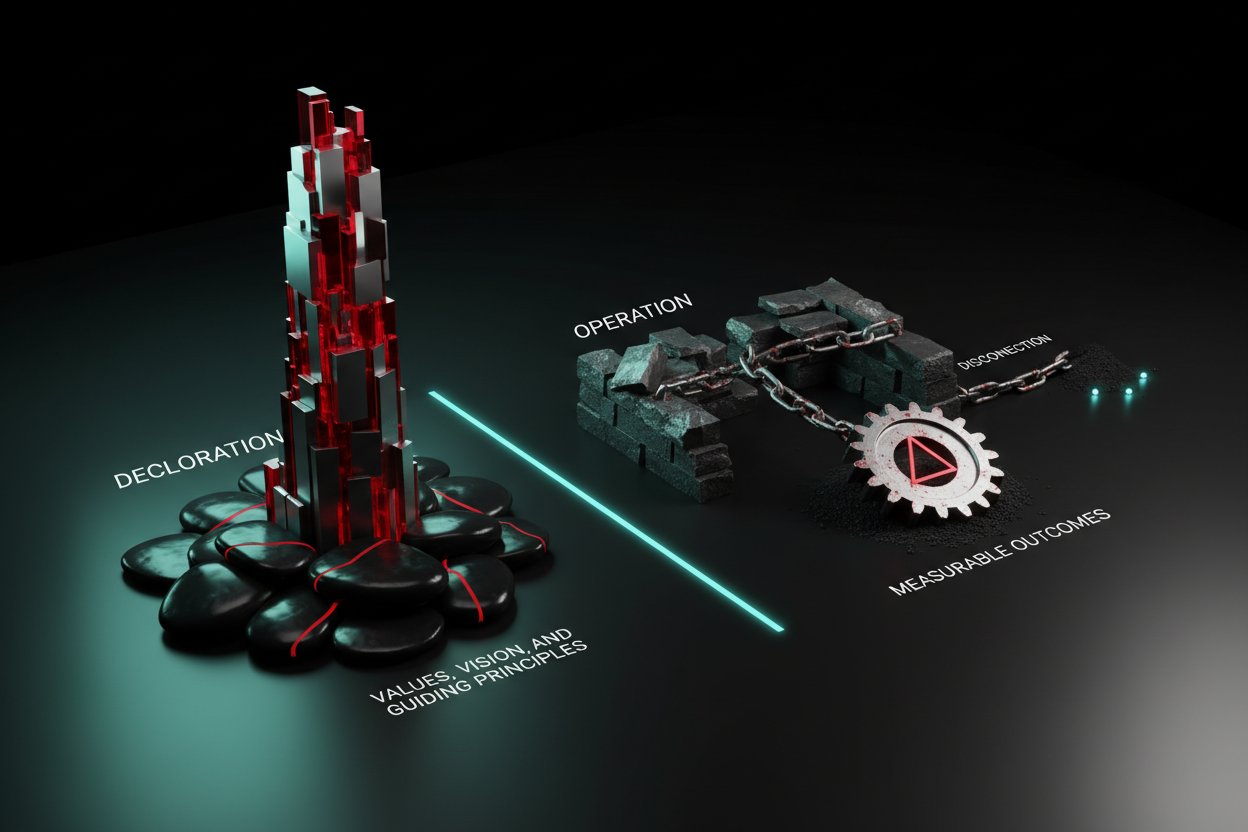
The Disconnection Between Declaration and Operation
Research on employee branding effectiveness from 2023-2024 indicates that values operationalization—translating abstract principles into behavioral expectations—is the primary differentiator between decorative and functional organizational values. Organizations declare "integrity" without defining what integrity looks like when a customer requests something that benefits them but strains the team. They claim "innovation" without clarifying whether innovation means taking risks that might fail or optimizing what already works.
According to Harvard Business Review's research on organizational culture, effective control environments require that organizational values translate into operational principles that guide daily decisions. The gap between stated values and lived behavior isn't a culture problem—it's an architecture problem. Values without operational translation are load-bearing walls that bear no actual load.
The Sequence Problem: Building Out of Order
Most organizations approach brand identity as a buffet: pick some values here, craft a vision there, define a mission somewhere else. But architecture doesn't work that way. You don't install windows before framing walls. You don't pour a foundation after building the roof.
Brand identity architecture requires specific sequence:
- Purpose (Why): The foundational reason your organization exists beyond profit
- Vision (Where): The future state purpose is moving toward
- Mission (What): The specific work that advances the vision
- Values (How): The principles that govern how mission work gets done
- Guiding Principles (When): The decision-making rules that operationalize values
Each element must inform the next. Vision disconnected from purpose drifts into aspiration without anchor. Mission disconnected from vision becomes activity without direction. Values disconnected from mission remain abstract rather than instructional.
The Brand Identity Architecture Framework: Five Load-Bearing Elements
This framework treats brand identity as infrastructure—each element connecting to others, bearing organizational weight, and enabling the structure you're trying to build. If you've completed our brand identity gap assessment, you've already identified which elements need the most attention.
Element One: Purpose—The Foundation
Purpose answers: Why does this organization exist beyond making money? What change are we trying to create in the world?
Purpose isn't a marketing statement. It's the foundation that everything else rests on. Weak purpose produces organizations that chase whatever opportunity appears most profitable, then wonder why they lack coherent identity.
Purpose Development Process:
- Identify the problem you're solving (not the product you're selling)
- Articulate who experiences that problem most acutely
- Define the change that would exist if your organization succeeded completely
- Test: Would this purpose still matter if your current products disappeared?
Strong purpose survives product pivots. It clarifies which opportunities fit and which don't. It gives team members language for why their work matters.
Element Two: Vision—The Direction
Vision answers: What does success look like? What future are we building toward?
Vision translates purpose into a specific destination. Purpose says why the journey matters; vision says where it's heading. Without vision, purpose remains noble but nebulous. Without purpose, vision lacks the "why" that sustains effort.
Vision Development Process:
- Project 10-15 years forward: If purpose were fully realized, what would be true?
- Make it concrete enough to measure progress, aspirational enough to inspire effort
- Test: Does this vision directly serve purpose? Could we achieve this vision and fail our purpose?
- Ensure vision is ambitious but achievable—not fantasy, not incremental
Element Three: Mission—The Work
Mission answers: What specific work advances the vision? What are we actually doing?
Mission is where strategy meets identity. It defines the scope of organizational effort—what you do and, crucially, what you don't do. Mission without vision produces activity without direction. Vision without mission remains aspiration without action.
McKinsey's analysis on organizational purpose and performance demonstrates how effective organizations connect mission statements to measurable strategic objectives. Mission isn't a tagline—it's a scope definition that enables strategic focus.
Mission Development Process:
- Define the core activities that advance vision
- Establish boundaries: what we do, what we don't do, what we might do later
- Test: Does every major activity connect to mission? Does mission clearly advance vision?
- Make mission specific enough to guide resource allocation decisions
Element Four: Values—The Principles
Values answer: How do we do the work? What principles govern our behavior?
Values are the most abused element in brand identity work. Generic values like "integrity," "excellence," and "teamwork" appear on 85-95% of corporate value statements. When everyone claims the same values, values differentiate nothing and guide nothing.
Effective values share specific characteristics:
- Distinctive: They differentiate you from competitors who might reasonably choose differently
- Tension-revealing: They help choose between competing goods, not just reject obvious wrongs
- Behavior-guiding: They translate into observable actions and decisions
- Trade-off clarifying: They make clear what you'll sacrifice to honor them
Harvard Business Review's research on purpose-driven strategy demonstrates that organizations using structured frameworks for brand identity development show measurably higher alignment between stated and lived values. The difference isn't aspirational wording—it's operational translation.
Element Five: Guiding Principles—The Application
Guiding principles answer: When values conflict, what takes precedence? How do values translate into specific situations?
This element bridges the gap between values and daily decisions. Values say "customer focus." Guiding principles say "when customer requests conflict with employee wellbeing, we prioritize sustainable capacity over short-term satisfaction."
Guiding Principles Development Process:
- Identify recurring decision points where values get tested
- Define specific guidance for each situation type
- Establish hierarchy: when values compete, which wins?
- Create concrete examples team members can reference
Operationalizing Your Architecture: From Framework to Daily Decisions
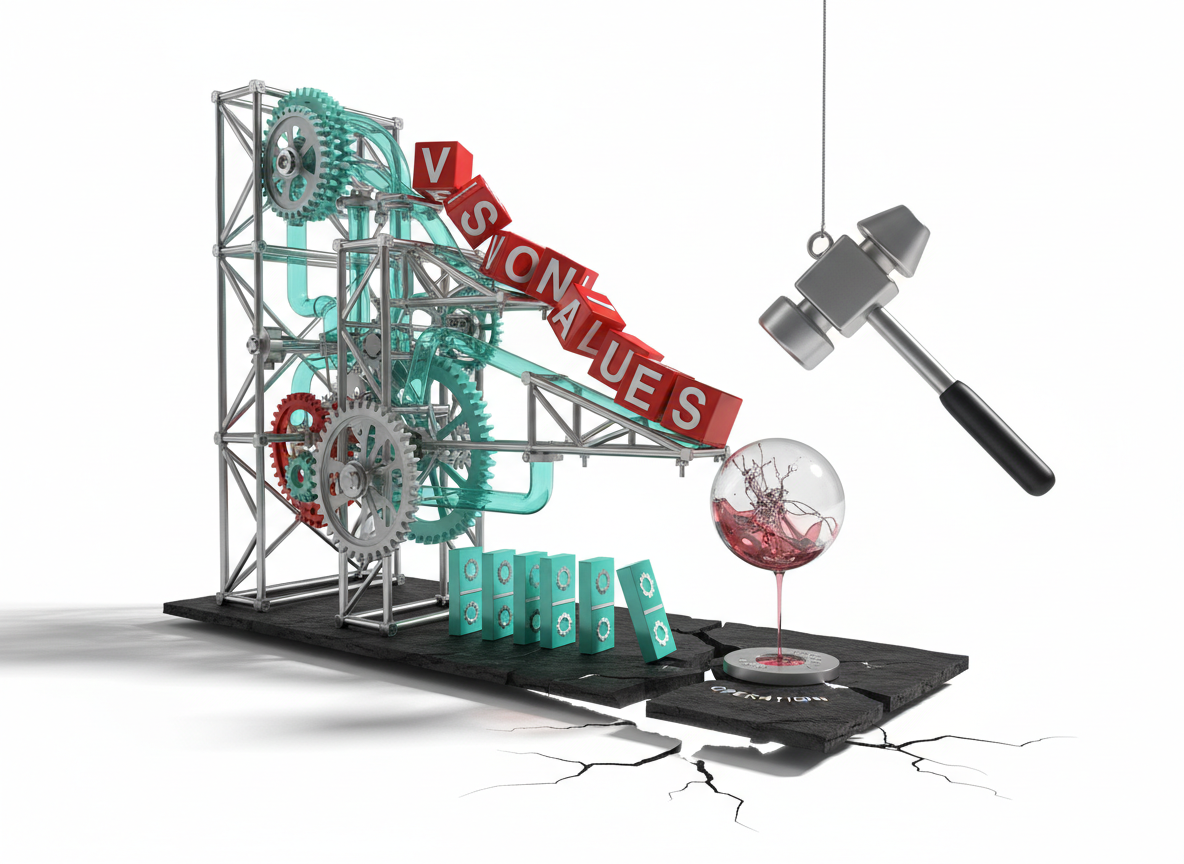
Architecture that exists only in documents creates no structural support. The framework must translate into operational systems—hiring criteria, performance evaluation, decision-making protocols, and resource allocation priorities. Our guide on implementing brand identity into organizational systems provides detailed implementation pathways.
Values-to-Behavior Translation Tables
For each value, create explicit translation into observable behaviors:
| Value | Looks Like (Observable Behavior) | Doesn't Look Like (Red Flags) |
|---|---|---|
| "Radical Transparency" | Sharing financial realities with team, explaining decision rationale, acknowledging uncertainty | Withholding information "to protect" people, making decisions without context-sharing |
| "Client Partnership" | Saying no to requests that don't serve client outcomes, challenging assumptions | Agreement to avoid conflict, doing whatever client asks regardless of wisdom |
This translation work transforms abstract values into actionable guidance. Team members know what behaviors demonstrate values and what behaviors violate them.
Decision-Making Integration
Brand identity architecture earns its investment when it informs real decisions:
- Strategic decisions: Does this opportunity advance our mission? Does it align with our values?
- Hiring decisions: Will this candidate operate according to our guiding principles?
- Resource allocation: Which investments most directly serve our vision?
- Partnership decisions: Do potential partners share compatible values?
If brand identity doesn't change how decisions get made, it's decoration—not architecture.
Testing Your Architecture: The Weight-Bearing Assessment
Effective brand identity architecture passes specific tests. Use these assessments to evaluate whether your framework provides structural support or merely exists as documentation.
The Sequence Test
Can you trace a clear line from purpose through vision through mission through values to daily decisions? If any element disconnects from those adjacent to it, the architecture has gaps that will show under pressure.
The Decision Test
Take a recent difficult decision your organization faced. Did your brand identity elements clarify the choice? If you can arrive at the same decision without referencing purpose, vision, mission, or values, those elements aren't load-bearing.
The Trade-Off Test
Can you name what you'd sacrifice to honor each value? Values without trade-offs are preferences, not principles. If "customer focus" doesn't require sacrificing something else, it's not a value—it's an aspiration everyone shares.
The Outsider Test
Could a new team member understand how to make decisions based on your documented architecture? If your identity elements require extensive interpretation or insider knowledge, they lack the specificity operational guidance requires.
Building Architecture That Holds Weight
Brand identity architecture isn't about finding perfect words. It's about building a structure where each element connects to others and translates into operational reality. Purpose informs vision. Vision shapes mission. Mission requires values. Values generate guiding principles. Guiding principles inform daily decisions.
The 2am anxiety about whether your organization actually stands for something—that's real. The frustration when team members make decisions that contradict stated values—that's valid. But these aren't character failures or culture problems. They're architecture problems. And architecture problems have architecture solutions.
Start with honest assessment of your current state. Build in sequence. Translate each element into operational expectations. Test the architecture under real decision-making pressure. Refine what doesn't hold weight.
Clarity precedes growth. And clarity, in this context, means architecture you can trust—systems that support the organizational weight you're asking them to bear.
Frequently Asked Questions
What is brand identity architecture?
Brand identity architecture is the structured system of interconnected foundational elements—purpose, vision, mission, values, and guiding principles—that inform organizational decisions and behavior. Like building architecture, each element bears weight and connects to others. Architecture approaches brand identity as infrastructure rather than marketing collateral.
How does a brand identity framework compare to a brand kit?
A brand kit addresses visual and verbal consistency—logos, colors, fonts, tone of voice. A brand identity framework addresses organizational alignment—purpose, values, decision-making principles. Brand kits ensure you look consistent externally; frameworks ensure you operate consistently internally. Both matter, but frameworks must precede kits to be meaningful.
How does bottom-up values discovery compare to top-down values definition?
Top-down values are declared by leadership based on aspiration—who we want to be. Bottom-up values are discovered through employee input—who we actually are. Effective frameworks combine both: discover existing cultural strengths (authenticity) while aspiring toward needed growth areas (direction). Pure top-down feels imposed; pure bottom-up reinforces status quo.
Why do my stated values feel disconnected from daily operations?
Values-operations disconnection occurs when values lack translation into behavioral expectations and decision-making guidance. Abstract values like 'integrity' or 'excellence' require operationalization: what does integrity look like in our customer service? Excellence in our production process? Without this bridge, values remain aspirational rather than instructional.
How do I identify which values will actually guide decisions versus decorate walls?
Values that guide decisions are specific enough to help choose between competing goods—not just reject obvious wrongs. 'Customer first' sounds good until customer demands conflict with employee wellbeing. Test proposed values with real dilemmas your team has faced. If the value doesn't clarify the choice, it's decoration, not guidance.
Sources
- Keep Exploring This Topic
Continue with the strongest related paths.
These links stay inside the same published content group so the next step feels like a continuation of the answer, not a detour.
Related ReadingAction PlanHow Clean Books Increase Business Valuation: The Due Diligence Multiplier
When buyers look at your business, they're pricing risk as much as revenue. Messy books signal hidden problems even when there aren't any. This article provides the specific audit a business owner needs to prepare their financial systems for a valuation event—whether they're selling next year or in ten.
FrameworkAccurate Data vs. Fast Data: Finding the Balance That Actually Improves Decisions
Learn how to balance data accuracy and speed for better business decisions. Discover the 'true enough, soon enough' framework that drives real results.
GuideHow Real-Time Financial Data Changes the Decisions You Make Today
Discover how real-time financial data transforms reactive firefighting into proactive leadership. Learn why delayed reporting costs you decisions.
Key Termsfinancial13-Week Cash Flow Forecast
The 13-Week Cash Flow Forecast is a tool that projects a business's expected weekly cash position over the next 3 months. It accounts for when the business expects to collect receivables and when it must pay obligations, allowing the business to identify and address potential cash flow gaps before they occur.
operational44/24 Problem
The 44/24 Problem refers to the disconnect between the organizations reporting AI-driven workforce efficiency gains and those seeing corresponding profit impact. This suggests that efficiency without proper alignment and integration of AI can result in faster chaos rather than tangible business benefits.
leadershipAccuracy Anxiety
The cultural resistance to using 'good enough' data for decision-making, even when waiting for perfection is more costly.
financialburn rate
Burn rate refers to how quickly a company spends its available cash reserves to cover operating expenses. It's typically measured monthly and helps business owners understand how long they can continue operations before running out of money or needing additional funding.
Stay Informed
Weekly insights, no spam