

The Hidden Cost of 'Figure It Out' Leadership: Why Growth-Stage Businesses Stall

Credentials
20+ yrs operational leadership | 300+ team across 7 locations at peak | 1,000+ led career-total | Diamond-level Allergan (#3 nationally) | VC / strategic investment evaluation | Startup operator | Top 1% national revenue | Automation systems since 2006
Growth-stage businesses stall when founders remain the bottleneck for every decision. The cost includes delayed opportunities, team dependency on one person, and decision fatigue that leads to inconsistent choices. Building decision-making infrastructure—clear systems, documented processes, and distributed authority—breaks this pattern and enables sustainable scaling.
You built this business on instinct, grit, and an almost irrational willingness to figure it out. Every challenge that came your way, you handled. Every fire, you extinguished. Every decision, you made. And it worked—spectacularly. You went from nothing to a real business with real revenue and real people depending on you.
So why does success feel so much like a trap?
In my twenty-plus years working with growth-stage businesses—from Diamond Allergan practices to multi-location service operations—I've watched this pattern repeat with painful consistency. The very resourcefulness that created the business becomes the ceiling that constrains it.
The Founder Dependency Ceiling: When Your Greatest Strength Becomes Your Biggest Constraint
According to the 2023 EOS Worldwide Survey, 60-70% of growth-stage businesses cite 'founder as bottleneck' as their primary scaling constraint. That statistic should stop you cold—not because it's alarming, but because it's probably describing your Tuesday.
How Dependency Actually Shows Up
Founder dependency rarely announces itself. It disguises itself as dedication, involvement, and necessary leadership. But the symptoms are unmistakable once you know where to look:
- Your inbox contains dozens of decisions only you can make
- Projects stall the moment you're unavailable or traveling
- Your team prefaces questions with "I know you're busy, but..."
- You haven't taken a real vacation in years—one where you actually disconnected
- Revenue grows, but your personal bandwidth never does
The business runs. But it doesn't run without you. That distinction matters more than any growth metric on your dashboard.
The Invisible Tax on Your Team
When you're the hub of every wheel, your team pays a tax you never see on the P&L. They wait. They second-guess. They develop learned helplessness because initiative without your approval has failed before. The capable people you hired to think independently start asking permission for decisions they should own.
This isn't a character flaw in your team. It's a systems problem. You've accidentally designed an organization where the safest path is always through you.
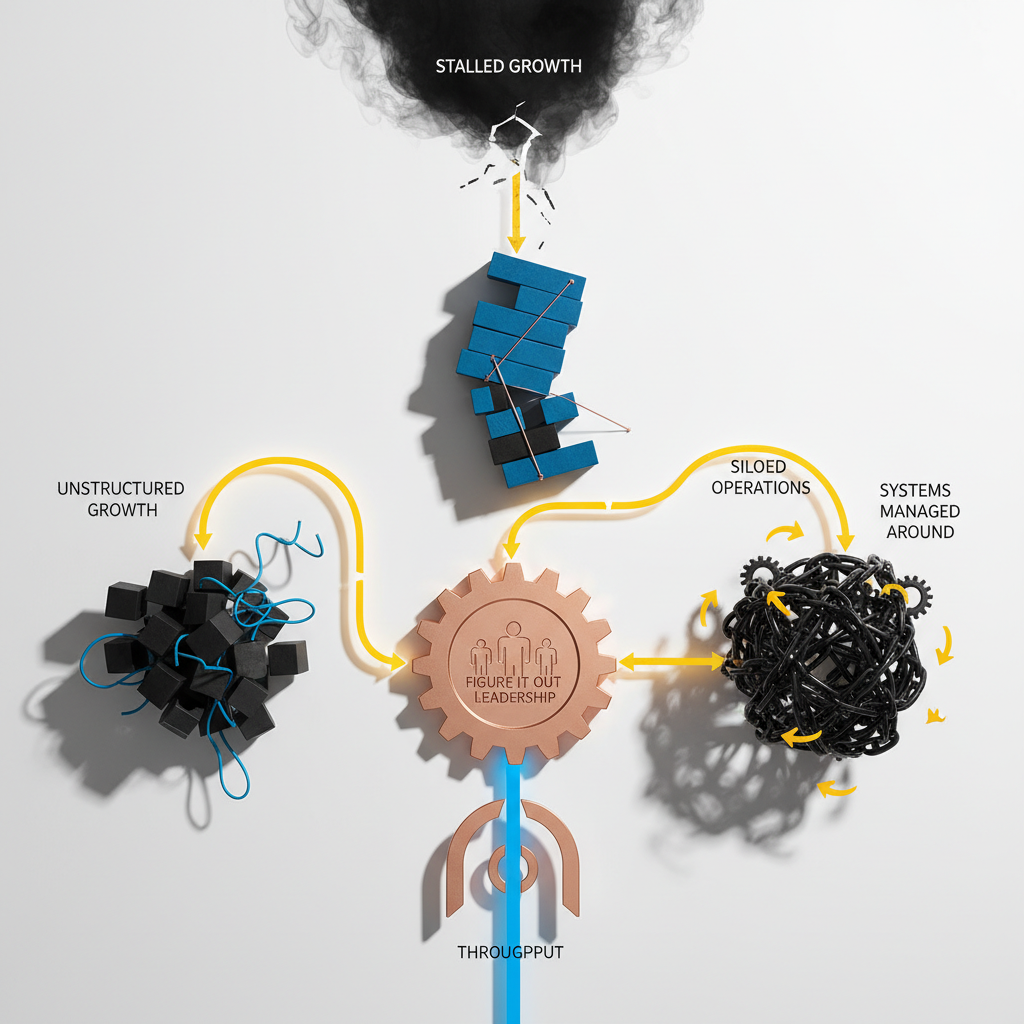
Decision Fatigue: The 2am Problem Nobody Talks About
Research published in the Journal of Personality and Social Psychology found that decision fatigue leads to 30-40% worse decisions by end of day compared to morning decisions. For founders making hundreds of micro-decisions daily, this isn't an abstract concern—it's the reason you said yes to that partnership you now regret and no to the opportunity you can't stop thinking about.
The Compound Cost of Constant Decisions
Every decision you make—from approving a vendor invoice to choosing the new CRM to deciding what to have for lunch—draws from the same cognitive account. By 3pm, that account is overdrawn. By 9pm when you're finally "catching up on email," you're making strategic choices with the mental clarity of someone on their third glass of wine.
The 2am anxiety many founders experience isn't weakness—it's your brain replaying decisions made with depleted resources, wondering which ones will come back to haunt you.
From Gut Instinct to Data-Informed Decisions
I'm not suggesting your instincts are wrong. They got you here. But instinct without infrastructure means every decision requires your full attention. When you build systems that surface the right information at the right time, you don't eliminate judgment—you preserve it for decisions that actually need it.
The goal isn't faster answers. It's truer ones—and a system that produces them whether you're sharp at 8am or depleted at 8pm.

The Three Invisible Bottlenecks That Keep Smart Leaders Stuck
Understanding what clarity-first consulting actually means starts with recognizing the bottlenecks that remain invisible precisely because they're woven into daily operations.
Bottleneck #1: Information That Lives in Your Head
Your team can't make good decisions if they don't have the same information you do. But most of that information—the context, the history, the "why we tried that before"—lives exclusively in your memory. Every time someone needs background, they come to you. Not because they're lazy, but because you're the only database.
This isn't about writing SOPs for everything. It's about building operational intelligence that captures institutional knowledge in accessible, actionable formats.
Bottleneck #2: Authority Without Boundaries
When team members don't know what decisions they can make independently, they default to asking. When they've been burned for making the "wrong" call without checking, they ask even more. The absence of clear decision rights creates a gravitational pull back to you.
Real authority distribution requires more than saying "I trust you." It requires documented boundaries: what decisions belong to which roles, what requires escalation, and what success looks like when you're not watching.
Bottleneck #3: Systems You Manage Around Instead of Through
Most growth-stage businesses have accumulated tools, processes, and "the way we do things" through necessity rather than design. The result is a patchwork that requires tribal knowledge to navigate. Your team doesn't work through systems—they work around them, constantly improvising.
You don't need more systems. You need systems you can trust. Infrastructure that handles the predictable so human intelligence focuses on the exceptional.
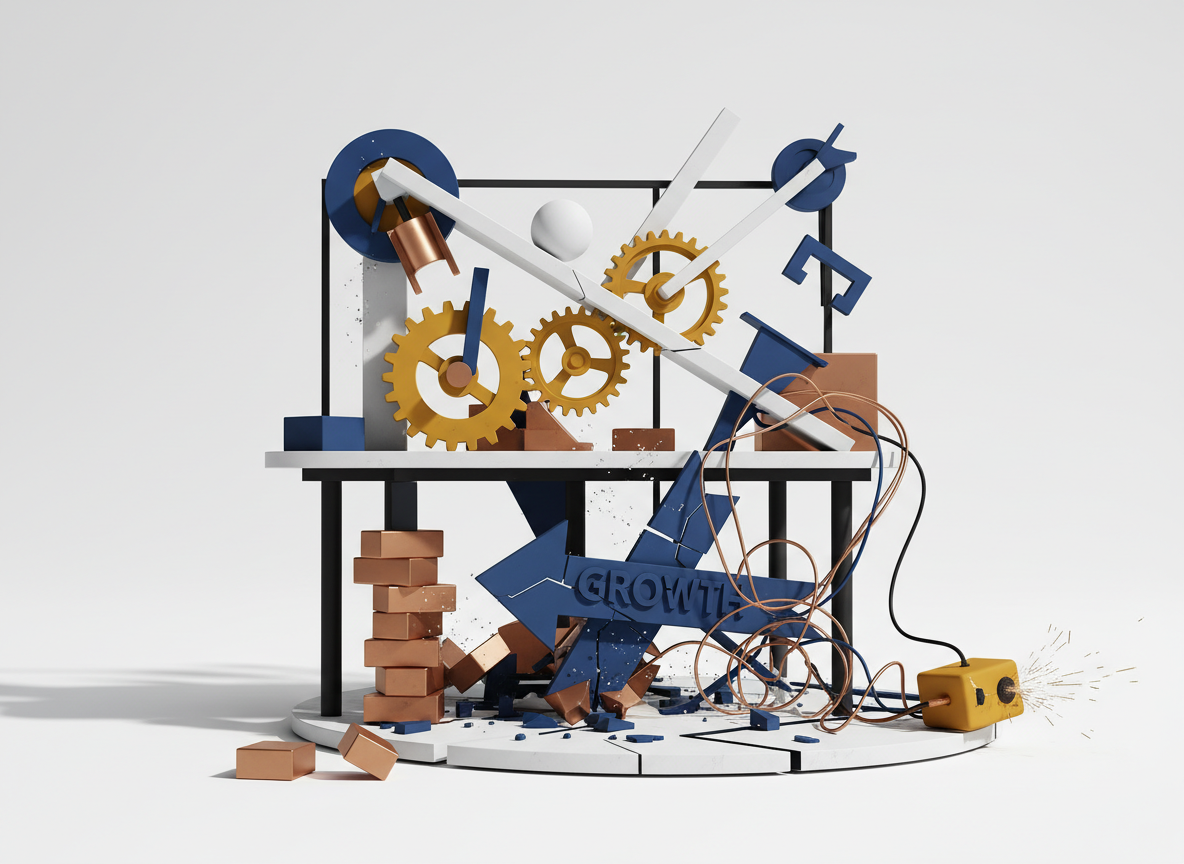
Reactive Mode vs. Strategic Growth: Recognizing the Difference
Understanding when a business is ready for strategic consulting often means recognizing you've been stuck in reactive mode so long it feels normal.
The Reactive Mode Trap
Reactive mode feels productive. There's always something urgent demanding attention, always a fire to fight, always a crisis to manage. The adrenaline of problem-solving can even feel addictive. But motion isn't progress.
You're profitable on paper but feel broke in your bandwidth. You're growing but not compounding. You're busy—exhaustingly, relentlessly busy—while strategic priorities gather dust on next quarter's list.
What Strategic Growth Actually Looks Like
Strategic growth feels different. Calmer. Decisions flow from architecture rather than heroics. Your team executes against priorities that compound rather than just responding to what's loudest. You think in quarters, not just today.
This doesn't mean passive or slow. It means intentional. Alignment between vision, decision-making, and systems creates compound returns that reactive scrambling never will.
Breaking the Pattern: From Founder Hero to Systems Architect
The shift from "figure it out" leadership to sustainable scaling isn't about working harder or hiring more people. It's about building decision-making infrastructure—the architecture that lets your business grow beyond your personal bandwidth.
Step One: Audit Your Decision Flow
Track every decision that crosses your desk for one week. Not just the big ones—every approval, every "quick question," every choice that couldn't happen without you. This audit typically reveals that 55-65% of those decisions could belong to someone else with the right information and authority.
Step Two: Document the Why, Not Just the What
Your team doesn't just need to know what to do. They need to understand why—the context, the principles, the factors you weigh. When you document decision criteria rather than just outcomes, you transfer judgment, not just tasks.
Step Three: Build Incrementally, Not Comprehensively
You don't need to systematize everything at once. Start with the five decisions that hit your desk most frequently. Create the information access, authority boundaries, and success criteria that let someone else own them. Then repeat.
Clarity precedes growth. You can't scale what you can't see, and you can't delegate what isn't defined.
The Path Forward: Growth You Can Trust
The hidden cost of "figure it out" leadership isn't just exhaustion—though that's real enough. It's opportunity cost. Every hour you spend as chief problem-solver is an hour you're not spending as strategic architect. Every decision that flows through you is a decision your team didn't learn to make.
What got you here won't get you there. But that's not failure—it's evolution. The same resourcefulness that built this business can build something better: decision-making infrastructure that compounds rather than constraints.
You don't need to stop being essential. You need to stop being the bottleneck. The difference is everything.
Frequently Asked Questions
What is founder dependency and why does it limit growth?
Founder dependency occurs when a business cannot make significant decisions without the founder's direct involvement. This creates a scaling ceiling because the founder's time and energy become the limiting factor—no matter how much revenue grows, operational capacity remains tied to one person's bandwidth. Breaking this requires building decision-making infrastructure that distributes authority systematically.
What is decision fatigue and how does it affect business owners?
Decision fatigue is the deteriorating quality of decisions made after a long session of decision-making. For business owners handling hundreds of micro-decisions daily, this leads to either impulsive choices or complete avoidance. The result is inconsistent direction, delayed opportunities, and that 2am anxiety wondering if you made the right call.
How does startup growth differ from growth-stage scaling?
Startup growth relies on founder intuition, speed, and resourcefulness—doing whatever works to survive. Growth-stage scaling requires repeatable systems, distributed decision-making, and documented processes. The skills that build a $1M business actively hinder a $10M business because scale demands architecture, not heroics.
What's the difference between being busy and being productive as a business owner?
Busy means responding to whatever demands your attention—reactive, firefighting, exhausting. Productive means executing against priorities that compound toward strategic goals. Many growth-stage owners are extremely busy while their businesses remain stuck because activity without architecture creates motion without progress.
How do I identify if founder dependency is limiting my business?
Audit your last week: How many decisions required your direct approval? Could your team handle a week without you? Do projects stall when you're unavailable? If the answer reveals you as the hub of every wheel, founder dependency is your ceiling. The business runs, but it doesn't run without you.
Sources
Continue with the strongest related paths.
These links stay inside the same published content group so the next step feels like a continuation of the answer, not a detour.
What Is the Core Cycle? The Natural Rhythm Behind Sustainable Business Growth
Learn the Core Cycle framework—Reveal, Refine, Enable, Optimize—for sustainable business transformation without disrupting your operations. Start where friction is highest.
What 'I Can't Afford It' Actually Means: The Objection That Reveals Your Consultation Gap
About 90% of 'I can't afford it' objections have a way forward—because they're rarely about money. This article reveals what the prospect is actually telling you: something in your consultation failed to connect your solution to their deepest pain. Understanding this reframe changes everything about how you respond.
The Listening Gap: Why Your Prospects Don't Feel Understood (And Say They Can't Afford You)
When prospects say 'I can't afford it,' they're often saying 'you didn't hear me.' This article examines how rushing to present solutions before fully understanding the prospect's true problem creates a disconnect that no amount of feature-selling can bridge. The gap isn't in your pitch—it's in your listening.
AI Alignment Priority Order
AI Alignment Priority Order is a three-layer sequential framework for improving visibility in AI recommendation engines. It requires businesses to first establish clarity by unifying their identity across all digital platforms, then build trust through reviews and third-party mentions, and finally optimize content for AI parsing. This specific order matters because each layer depends on the one below it.
AI Recommendation Engines
AI recommendation engines are systems like ChatGPT, Perplexity, and Gemini that answer questions by synthesizing information from across the web rather than just showing search results. When someone asks for a business recommendation, these engines evaluate multiple signals including your website, reviews, directory listings, and third-party mentions to decide whether to recommend you. They require clarity, consistency, and external validation before citing a business with confidence.
AI Visibility Audit
An AI visibility audit is a diagnostic process where you test what AI recommendation engines actually know about your business by asking them directly. You query tools like ChatGPT, Perplexity, and Gemini with questions about your services and business name, then compare their responses to reality. Gaps in their knowledge reveal problems with how AI can parse your content, validate your credibility, or identify your business consistently across the web.
Alignment
When vision, decision-making, and systems are no longer in conflict.
Stay Informed
Weekly insights, no spam