

Why Your Med Spa Is Busy But Not Profitable: The Volume Trap Explained

Credentials
20+ yrs operational leadership | 300+ team across 7 locations at peak | 1,000+ led career-total | Diamond-level Allergan (#3 nationally) | VC / strategic investment evaluation | Startup operator | Top 1% national revenue | Automation systems since 2006
A busy med spa often isn't profitable because appointment volume doesn't equal margin. When schedules fill with discounted services, low-priced treatments, or time-intensive procedures that don't match their revenue, you're trading hours for minimal return. The fix starts with measuring revenue per provider hour, not just bookings.
You look at your schedule and see back-to-back appointments. Providers hustling. The waiting room full. Every room occupied. By any visible measure, your med spa is thriving.
Then you look at your bank account. And the numbers don't match the chaos.
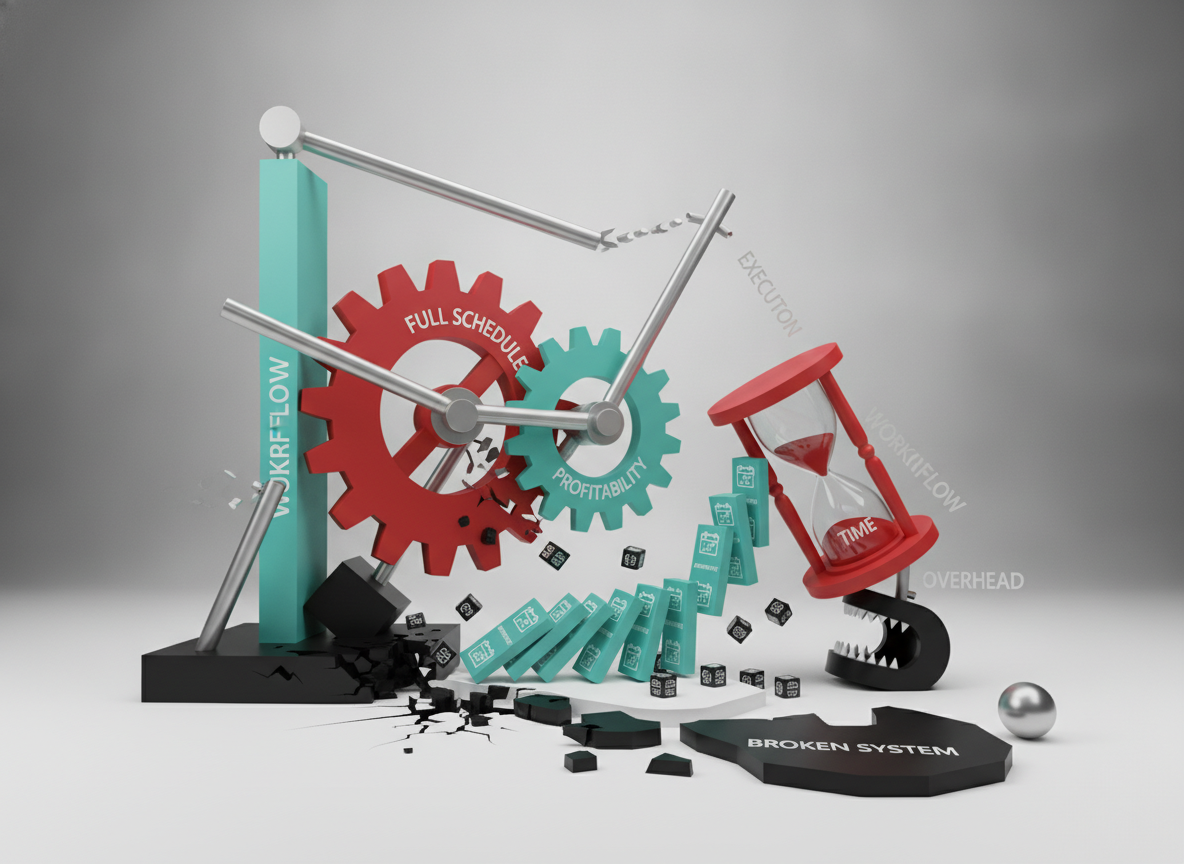
This is the volume trap—the quiet drain that convinces busy med spa owners they're succeeding when, in reality, their business is slowly bleeding margin with every appointment booked. The problem isn't that you need more clients. The problem is that you're measuring the wrong thing.
The Illusion of a Full Calendar
Why Appointments Don't Equal Profit
A full schedule feels like success because it's tangible. You can see it. You can feel the energy of a busy practice. But appointments are a volume metric—they tell you how many transactions occurred, not whether those transactions built or eroded your financial foundation.
Consider two scenarios:
- Provider A completes eight appointments in a day, generating $2,400 in revenue.
- Provider B completes four appointments in a day, generating $2,800 in revenue.
Provider A looks busier. Provider B is more profitable. The difference comes down to what fills those hours, not how many hours are filled.
The Discount Dependency Spiral
Many med spas fall into a pattern: attract clients with aggressive discounts, fill the schedule, then struggle to convert those clients to full-price services. The calendar stays full because the deals keep flowing. But the margin on each appointment shrinks—sometimes to nothing, sometimes below zero once you factor in product cost, labor, and the overhead those hours consume.
Deal-site clients and deep-discount campaigns create a specific problem: they attract price-sensitive buyers who redeem one offer and rarely return at full price. You've paid to acquire them (often at significant cost in competitive markets), delivered service at a loss, and gained no long-term value. The schedule looked productive. The bank account disagrees.
Revenue Per Provider Hour: The Metric That Matters
What It Actually Measures
Revenue per provider hour calculates the average income generated during each hour a provider is actively working with clients. It's not total revenue divided by total hours the practice is open—it's revenue divided by the hours providers are actually delivering services.
This metric exposes the truth about your service mix. A practice generating strong monthly revenue might still have weak profitability if that revenue required excessive provider hours to produce. Conversely, a practice with lower topline revenue might be healthier if those dollars came from fewer, higher-margin hours.
Why Total Revenue Hides the Problem
Total monthly revenue is a vanity metric for operational decision-making. It tells you how much money moved through the business—not how efficiently that money was generated or how much you kept.
A med spa doing $150,000 monthly across 800 provider hours operates at roughly $187 per provider hour. A practice doing $100,000 across 400 provider hours operates at $250 per hour. The second practice likely has lower overhead, less burnout risk, and stronger margin—despite generating less total revenue.
When you optimize for total revenue, you naturally push for more appointments. When you optimize for revenue per provider hour, you naturally push for better appointments.

Where the Money Actually Leaks
Underpriced Time-Intensive Services
Some treatments consume significant provider time without commanding prices that reflect that time. Basic facials heavily discounted to compete. Consultations that run long without proper fees attached. Treatments priced years ago that never adjusted as labor costs increased.
If a service takes 90 minutes and generates $150, your revenue per hour on that service is $100. If your overhead and labor costs require $175 per hour to break even, you're losing money every time that service is booked—regardless of how "busy" it makes you feel.
Commission Structures Misaligned with Margin
Provider compensation is often set without clear visibility into what each service actually costs to deliver. High commissions on already-discounted services can leave the owner with minimal or negative margin—even as the provider earns well.
This isn't about reducing provider pay. It's about ensuring your pricing and compensation work together. When they don't, your busiest provider may also be your least profitable from the practice's perspective.
Underutilized High-Margin Equipment
Many med spas invest in expensive lasers, body contouring platforms, and energy-based devices that command premium pricing. These devices often sit underutilized while providers focus on injectables and lower-margin treatments they're more comfortable selling.
This creates a double problem: the device cost sits on your books without generating adequate return, and the hours that could be filled with high-margin device treatments are instead consumed by lower-margin services. Marketing habits, provider comfort, and weak scripting for premium offerings all contribute.
The KPIs You're Probably Not Tracking
Service-Level Profitability
Most med spa owners can tell you their top-selling services. Fewer can tell you which services are actually profitable after accounting for product cost, device amortization, room time, and staff expense. Without this visibility, you might be marketing aggressively for services that hurt you every time they book.
For a deeper look at identifying margin leaks, explore our guide on where med spa money is actually leaking.
Client Acquisition Cost Versus Lifetime Value
Acquiring new clients through paid channels in competitive markets can be expensive—sometimes significantly more than the margin on a single discounted treatment. If those clients don't return at full price, you've spent money to lose money.
Here's the number that should stop you mid-scroll: acquiring a new client typically costs 5 to 7 times more than retaining an existing one. In a med spa context, where a single new client acquisition through paid digital channels can run $80–$200 or more before they've booked a second visit, burning through clients isn't just a retention problem—it's a capital destruction problem. Every lapsed client you replace with a new one resets that cost clock entirely.
Tracking lifetime value against acquisition cost reveals whether your marketing is building the business or just creating expensive busy-work. Retention-focused investments—memberships, rebooking protocols, personalized treatment plans—typically cost far less than constantly acquiring new clients through paid campaigns.
Retail Attachment Rate
Take-home product sales often carry strong margins compared to service revenue. Many busy med spas show retail attachment rates well below their potential because providers aren't trained or incentivized to recommend home-care products. This leaves significant margin untapped while also reducing clinical outcomes and client retention.
Reframing What Success Actually Looks Like
From Volume to Value
The shift from volume-based thinking to value-based thinking changes every decision you make. Instead of asking "how do I fill more hours?" you ask "how do I make each hour count more?"
This means:
- Reviewing pricing against true delivery cost, not just competitor pricing
- Evaluating your service mix for margin contribution, not just popularity
- Building compensation structures that align provider incentives with practice profitability
- Marketing services based on their margin potential, not just their demand
The Discounting Trap Revisited
Discounts aren't inherently bad. Strategic introductory offers that convert to full-price loyalty can work. But discounting as a default—as a way to keep the schedule full—erodes margin systematically.
Our analysis of how discounting kills med spa margin breaks down where promotional pricing helps versus where it quietly drains profitability.
Scheduling for Margin, Not Just Capacity
Efficient scheduling means more than avoiding gaps between appointments. It means prioritizing higher-margin services during peak hours, structuring provider schedules around their highest-value skills, and ensuring room utilization supports your most profitable offerings.
The goal isn't an empty calendar—it's a calendar filled with services that build the business rather than just sustain activity.
How to Break Out of the Volume Trap
Clarity precedes growth. The architecture for fixing this is consistent across practices; the numbers you find will be specific to yours. Start here:
- Calculate revenue per provider hour. Divide total service revenue by total hours providers spent delivering those services—not hours the practice was open. Do this by service category, not just in aggregate. This single calculation will show you exactly where your time is being used profitably and where it isn't.
- Audit your three most-booked services for true margin. Pull your highest-volume services and account for every cost: product, device amortization, provider labor, room time, and allocated overhead. Many owners discover their most popular service is also their least profitable. That finding changes everything about how you market, schedule, and price.
- Cap default discounting. Set a clear policy on when and how much discounting is permitted. Introductory offers and strategic promotions are tools—but they require defined limits. If discounting is happening by default to fill gaps, establish a floor and hold to it. Margin lost to unnecessary discounts rarely comes back.
These three steps don't require a full operational overhaul to start. They require the right measurement, the right visibility, and a decision to act on what the numbers show.
Moving From Busy to Profitable
The volume trap isn't a character flaw—it's a systems problem. The metrics most visible (appointments, busy rooms, provider activity) don't align with the outcome you actually need (margin, cash flow, sustainable growth).
In my two decades of operational leadership across medical aesthetics and service businesses, I've seen this pattern repeatedly: practices that appear successful by activity metrics struggle financially because their measurement systems point toward volume rather than value.
The fix starts with measurement. When you track revenue per provider hour by service category, you see exactly where busy hours generate return and where they drain margin. That visibility creates the foundation for every pricing, scheduling, and marketing decision that follows.
You don't need fewer appointments. You need better ones. And the path to better starts with measuring what actually matters.

Frequently Asked Questions
What is revenue per provider hour in a med spa?
Revenue per provider hour measures the average income generated during each hour a provider is working with clients. Unlike total revenue, this metric reveals whether your team's time is being used profitably. Well-run med spas target specific revenue-per-hour thresholds for each service category to ensure busy hours translate to actual margin.
What does it mean when a med spa has high volume but low profit?
High volume with low profit means your schedule is filled with appointments that consume provider time without generating adequate margin. This typically happens when services are underpriced, discounted heavily, or require more time than their revenue justifies. The calendar looks successful, but the profit-and-loss statement tells a different story.
How does volume differ from profitability in a med spa business?
Volume measures how many appointments you book; profitability measures what you keep after costs. A med spa can have 40 appointments daily but lose money if those appointments are discounted injectables with high commission payouts. Profitability requires analyzing margin per service, not just service count.
How does revenue per hour compare to total monthly revenue as a metric?
Total monthly revenue shows topline growth but hides efficiency problems. Revenue per hour reveals whether each working hour generates adequate return. A practice doing $150K monthly across 800 provider hours ($187/hour) may be less profitable than one doing $100K across 400 hours ($250/hour) due to lower overhead and better margin.
Why do some med spas struggle to profit despite being fully booked?
Full books often reflect demand for discounted or low-margin services rather than profitable ones. When providers spend hours on treatments priced below their true cost—including labor, product, and overhead—the practice loses margin on every appointment. Without tracking revenue per hour by service, owners miss where the leak is occurring.
Continue with the strongest related paths.
These links stay inside the same published content group so the next step feels like a continuation of the answer, not a detour.
The Med Spa Benchmarking Trap: When Industry Averages Lead You Astray
Industry benchmarks can mislead your med spa. Learn why comparing your team's performance against itself—not national averages—reveals the signal that drives real growth.
Leading vs. Lagging Indicators: Why Your Med Spa Dashboard Is Showing You Yesterday's Weather
Learn why your med spa dashboard shows yesterday's results. Discover which leading indicators predict revenue 30-60 days ahead and create clarity that compounds.
Client Acquisition Cost Versus Lifetime Value
Client acquisition cost versus lifetime value is a critical financial metric that compares how much money a medical spa spends to attract a new client through marketing against the total profit that client generates over their entire relationship with the practice. If it costs more to acquire a client than they ever spend at full price, the business is essentially paying to lose money despite having a full schedule.
Discount Dependency Spiral
Discount dependency spiral is a destructive business pattern where medical spas become reliant on offering continuous discounts to keep their schedules full. This attracts price-sensitive customers who only book discounted treatments and rarely return at full price, forcing the business to keep offering deals just to maintain volume while steadily losing money on each appointment.
Service-Level Profitability
Service-level profitability is a detailed financial analysis that calculates whether each individual treatment or service offered by a medical spa is actually making money. It accounts for all the true costs of delivering that service, including products used, staff time, equipment depreciation, and overhead. This reveals which services are genuinely profitable versus those that look busy but actually lose money.
Volume Trap
The volume trap refers to a common business pitfall where a medical spa appears successful because it has a full schedule of appointments, but actually loses money because those appointments are filled with discounted or low-margin services. This creates the illusion of a thriving practice while the business slowly bleeds profitability with every booking.
Stay Informed
Weekly insights, no spam