
How do I make Google and AI both trust and cite my website?

Credentials
20+ yrs operational leadership | 300+ team across 7 locations at peak | 1,000+ led career-total | Diamond-level Allergan (#3 nationally) | VC / strategic investment evaluation | Startup operator | Top 1% national revenue | Automation systems since 2006
E-E-A-T stands for Experience, Expertise, Authoritativeness, and Trustworthiness—quality signals that both Google and AI systems use to evaluate content credibility. Demonstrating real experience through case studies, showcasing credentials, earning citations from authoritative sources, and maintaining factual accuracy improves visibility in traditional search and AI-generated responses simultaneously.
The question keeping business owners up at night has shifted. It's no longer "How do I game the algorithm?" It's "Why does my competitor show up in AI answers when I have better content?" The answer lies in a credibility framework that both Google and AI systems now share: E-E-A-T.
What does E-E-A-T actually mean for your business?
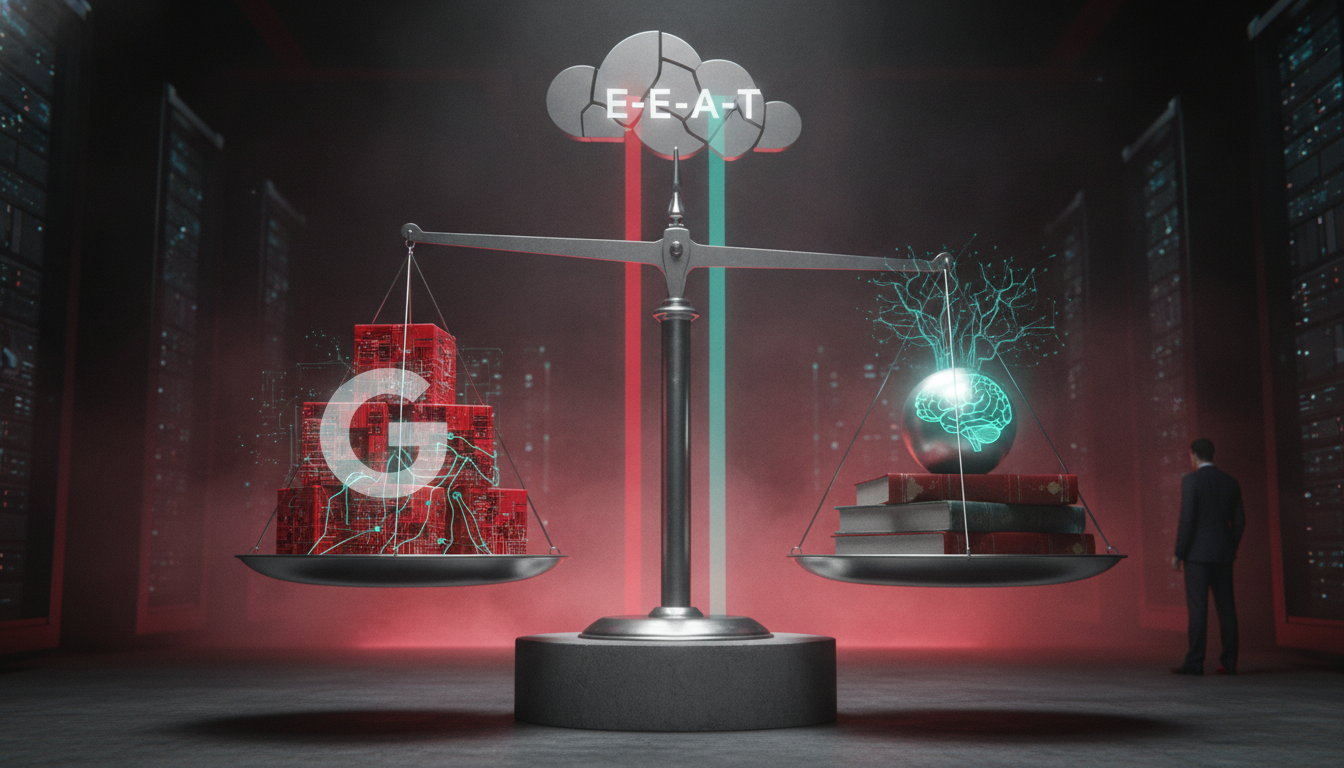
E-E-A-T stands for Experience, Expertise, Authoritativeness, and Trustworthiness—four pillars that map to specific, buildable signals. Google's Search Quality Evaluator Guidelines reference E-E-A-T more than 130 times, establishing it as central to content evaluation. The same logic now governs how AI systems decide what to cite. Each pillar is concrete, not abstract, and each can be improved with deliberate action.
The four pillars decoded
Experience asks: Has the creator actually done this? A consultant writing about scaling operations from firsthand client work carries different weight than someone summarizing business books. Google added this dimension in December 2022 specifically to distinguish practitioners from researchers.
Expertise evaluates depth of knowledge. Do you understand the nuances, the edge cases, the problems that only emerge in real implementation? Your content reveals this through specificity—not "improve your processes" but "document your top five revenue-generating workflows this week."
Authoritativeness measures industry recognition. Are other credible sources citing you? Do your credentials match your claims? This isn't about self-promotion. It's about whether your industry has validated your voice.
Trustworthiness encompasses everything: factual accuracy, transparent sourcing, honest representation of what you know and don't know. It's the foundation the other three pillars rest on.
Why Google and AI systems converge on credibility
According to Google's Search Central documentation on creating helpful content, the search engine aims to "reward content where visitors feel they've had a satisfying experience." AI systems face the same fundamental challenge: which sources should inform their responses?
Both systems need to answer the same question: Can we trust this content enough to show it to users? The mechanisms differ—Google ranks pages while AI generates responses—but the evaluation criteria overlap significantly. Strong E-E-A-T signals tell both systems: this source is safe to cite.

Why is building credibility worth more than chasing algorithm tactics?
Credibility infrastructure compounds over time in ways that algorithm tactics cannot. Each piece of content demonstrating genuine expertise becomes a citation source for AI systems. Each authoritative backlink strengthens your domain's credibility profile. Unlike paid visibility or keyword tricks, the returns accumulate rather than reset with every platform update or model change.

Moving beyond algorithm chasing
The tactics that worked for years—keyword stuffing, link schemes, thin content scaled through templates—no longer produce results. Google's Helpful Content Updates have shifted the landscape decisively toward demonstrated credibility. For business owners, the path forward isn't finding the next algorithm trick. It's demonstrating genuine expertise in ways that both humans and AI systems can verify.
The visibility anxiety at 2am isn't a character flaw—it's a systems problem. If your content isn't appearing where it should, you don't need more content. You need content that carries verifiable credibility signals.
Why credibility-building compounds
Compare credibility investment to paid advertising, where visibility ends when budget ends. Or to algorithm-chasing tactics that require constant adaptation as platforms change. Credibility infrastructure, once built, continues generating returns.
As we outline in our guide to building authority clusters for search visibility, strategic content architecture amplifies individual credibility signals into sustainable competitive advantage.

How do you actually build E-E-A-T signals into your content?
E-E-A-T is built signal by signal across four dimensions. Each pillar has concrete, actionable tactics—none of which require gaming anything. The goal is to make your real expertise visible and verifiable to both human readers and the systems that evaluate content on their behalf.
Demonstrating experience
Experience shows through specificity. Generic advice signals research; specific detail signals lived knowledge.
- Include case studies with real outcomes. Not "we helped a client grow" but "we identified a 32% revenue increase opportunity by restructuring their consultation process."
- Reference your actual process. In my 20+ years working with growth-stage businesses, I've seen the same pattern: profitable on paper, broke in the bank account. That's a visibility problem, not a revenue problem.
- Acknowledge complexity honestly. Document what worked, what didn't, and what you'd do differently. AI systems are trained to recognize hedging versus honest uncertainty.
Establishing expertise
Expertise requires depth, not breadth. According to the Content Marketing Institute's 2025 B2B Content Marketing report, the most effective content programs focus on specific topics where they can demonstrate genuine authority rather than covering everything superficially.
- Create content clusters around your core competencies. Shallow coverage of many topics signals generalist; deep coverage signals expert.
- Cite your own original research and frameworks. If you've developed proprietary methodologies, document them. AI systems recognize and cite original thinking.
- Connect concepts to practical application. Theory without implementation guidance lacks the specificity that signals real expertise.
Building authoritativeness
Authority isn't claimed—it's recognized. The signals here involve external validation.
- Earn citations from industry publications. Guest contributions, quoted expertise, collaborative research.
- Display verifiable credentials. LinkedIn profiles, professional certifications, speaking engagements. Make these easy for AI systems to verify.
- Maintain consistent topical focus. A site covering operations, finance, marketing, and leadership with equal depth appears authoritative in none.
Ensuring trustworthiness
Trust is the foundation. Without it, the other signals carry no weight.
- Cite sources for factual claims. AI systems cross-reference. Unsourced statistics raise flags.
- Update content regularly. Outdated information damages trust signals. Review and refresh key content annually at minimum.
- Be transparent about limitations. What you don't know matters as much as what you do. Honest boundaries signal trustworthiness.
How do AI systems decide which sources to cite in their responses?
AI systems generating responses must decide which sources to cite, paraphrase, or ignore entirely. The evaluation follows logic that closely mirrors what Google's quality evaluators assess—which is why building for one builds for both. Strong E-E-A-T makes AI confident in citing you; weak E-E-A-T means AI ignores your content even if you rank well in traditional search.

Understanding what is answer engine optimization (AEO) helps clarify the connection. AI systems look for: Does the author have relevant credentials? Does the content cite authoritative sources? Does the information match what authoritative sources report? Is the site's reputation consistent with its claims?
The credibility convergence
This convergence simplifies strategy. You don't need separate approaches for Google SEO and AI visibility. The credibility infrastructure that satisfies one satisfies both.
What actually works: build content that demonstrates genuine expertise, cite credible sources, maintain factual accuracy, and make your credentials verifiable. These aren't algorithm tricks. They're business fundamentals that both humans and AI systems can recognize.
How do I know if my current content is doing enough to establish credibility?
Auditing your E-E-A-T signals means examining five specific areas: author credentials, source citations, backlink quality, brand reputation, and whether your content reflects firsthand experience or generic advice. Running this audit systematically surfaces the gaps most likely to cost you visibility in both Google rankings and AI-generated responses.
Review your author bios for visible credentials and direct experience. Check whether your content cites sources and includes original data or insights. Audit your backlink profile for authoritative referring domains. Search your brand name to assess how your reputation appears to outside systems. Examine your content for concrete specificity versus generic summaries—AI systems are well-calibrated to tell the difference. Document gaps and prioritize improvements based on what your industry's credibility standard actually requires.
What should I do next to start improving my E-E-A-T?
E-E-A-T isn't a checklist to complete. It's infrastructure to build. The businesses that treat credibility as a strategic asset—documenting expertise, earning recognition, maintaining accuracy—create visibility that compounds over time.
Stop chasing algorithm tricks. Start building the credibility signals that both Google and AI systems use to decide which voices deserve amplification. The investment isn't in gaming systems. It's in becoming genuinely authoritative.
That's the path from busy-but-invisible to strategically positioned. Not faster content—truer content. Not more noise—signal that carries.

Frequently Asked Questions
What is E-E-A-T and why did Google add Experience?
E-E-A-T stands for Experience, Expertise, Authoritativeness, and Trustworthiness. Google added Experience in December 2022 to distinguish first-hand knowledge from secondhand research. A plumber who writes about fixing pipes from actual job experience ranks differently than someone summarizing plumbing articles. This change rewards practitioners, not just researchers.
What does Authoritativeness mean for business websites?
Authoritativeness measures whether your industry recognizes you as a credible source. Signals include citations from other reputable sites, mentions in industry publications, professional credentials, and consistent topical focus over time. For businesses, this means building a content portfolio that demonstrates deep knowledge in your specific area rather than shallow coverage of many topics.
How does E-E-A-T compare to traditional ranking factors like backlinks?
Backlinks remain important but now function as one E-E-A-T signal among many. A link from an authoritative industry site contributes to your Authoritativeness. But E-E-A-T also evaluates author credentials, content accuracy, site reputation, and demonstrated experience—factors that backlinks alone can't establish. E-E-A-T is the framework; backlinks are one input.
How does E-E-A-T affect AI citation differently than Google rankings?
Google uses E-E-A-T to rank pages in a list. AI systems use similar signals to decide which sources to cite in generated responses. The difference: Google shows your link; AI might quote your content directly. Strong E-E-A-T makes AI more confident paraphrasing you, while weak E-E-A-T means AI ignores your content even if you rank well.
Sources

Continue with the strongest related paths.
These links stay inside the same published content group so the next step feels like a continuation of the answer, not a detour.
GEO Explained: How to Optimize Your Content for ChatGPT and AI Search
Learn how Generative Engine Optimization (GEO) helps your business get cited by ChatGPT and AI search. Practical strategies for AI-first content visibility.
What Is Answer Engine Optimization (AEO) and Why Your Business Needs It Now
Answer Engine Optimization (AEO) helps your content become the direct answer AI and voice assistants deliver. Learn why AEO matters now and how to implement it.
What Reactive Marketing Actually Costs You (Beyond the Budget Line)
Discover the true reactive marketing cost—decision fatigue, team burnout, and zero compounding returns. Learn why it's an infrastructure problem, not a budget issue.
Answer Engine Optimization (AEO)
Answer Engine Optimization refers to the practice of optimizing content to be featured in AI-generated responses. This involves ensuring the content demonstrates strong credibility signals like experience, expertise, authoritativeness, and trustworthiness so that AI systems will recognize and cite it.
AI-Mediated Discovery
AI-mediated discovery is the process by which potential clients discover and evaluate businesses through artificial intelligence-generated recommendations rather than traditional search results. Instead of manually reviewing search engine listings, users receive synthesized answers from AI systems that cite trusted sources, fundamentally changing how businesses must approach digital visibility.
Authority-First Content Design
Authority-First Content Design refers to designing content with clear attribution of who created it and what makes them an expert on the topic. This helps AI models better understand the authority and credibility of the information.
Citation Signals
Citation signals are elements within content that indicate credibility and expertise to artificial intelligence models. These include author credentials, expert attributions, verifiable facts, and structural markers that help AI systems determine whether content is trustworthy enough to cite in their generated responses.
Stay Informed
Weekly insights, no spam