

The Listening Gap: Why Your Prospects Don't Feel Understood (And Say They Can't Afford You)

Credentials
20+ yrs operational leadership | 300+ team across 7 locations at peak | 1,000+ led career-total | Diamond-level Allergan (#3 nationally) | VC / strategic investment evaluation | Startup operator | Top 1% national revenue | Automation systems since 2006
The listening gap in sales consultations occurs when representatives focus on presenting solutions before fully understanding the prospect's true problem. When prospects don't feel heard, they struggle to see value in any solution offered. Closing this gap requires asking deeper questions and listening for the emotional weight behind their stated problems.
The Real Translation Behind "I Can't Afford It"
You've done the discovery call. You've presented your solution. You've walked through the investment. And then it comes: "I just can't afford it right now."
Here's what most sales professionals miss: that statement is almost never about math. It's about meaning. When a prospect doesn't feel understood, no price feels justified. They're not rejecting your number—they're rejecting a solution that doesn't feel calibrated to their actual problem.
The Value Perception Gap in Action
The value perception gap is the disconnect between what you're offering and what the prospect believes they need. This gap doesn't form because your solution lacks merit. It forms because somewhere in the conversation, you stopped listening and started solving.
In my twenty-plus years of operational leadership—building teams, scaling locations, working with founders who stare at the ceiling at 2am—I've watched this pattern repeat across industries. The consultant who loses the engagement isn't usually the one with the weaker methodology. It's the one who prescribed before they diagnosed.
What Prospects Actually Need to Hear
Your prospect walked into the conversation carrying something heavy. Maybe it's a process that's bleeding money. Maybe it's a team that's burning out. Maybe it's the quiet terror of watching revenue grow while profit disappears.
They need to know you see that weight before you offer to lift it. When you move too quickly to your framework, your deliverables, your timeline—you communicate that you're more interested in selling your solution than solving their problem.
Why Your Pitch Isn't Landing (It's Not the Pitch)
Most sales training focuses on objection handling—how to respond when the prospect pushes back. But the listening gap doesn't create objections. It creates disconnection. And disconnection can't be overcome with clever rebuttals.
The Difference Between Hearing and Understanding
There's a profound difference between listening to understand and listening to respond. When you listen to respond, you're scanning for trigger words—pain points that match your solution, problems you know how to fix. The moment you hear one, you start mentally assembling your pitch.
When you listen to understand, you hold space for the full picture to emerge. You notice the hesitation before certain topics. You hear the three problems mentioned but sense the fourth one that hasn't been named yet. You understand that the surface issue is rarely the whole story.
The Coaching Stance That Changes Everything
The most effective sales conversations in strategic consulting don't feel like sales conversations at all. They feel like coaching sessions. You're not positioning yourself as the expert with the answer. You're positioning yourself as the partner who helps them find their own clarity.
This coaching stance treats objections as alignment checks rather than obstacles. When a prospect says "I can't afford it," the coaching response isn't to justify the price. It's to explore what's underneath that statement. Is it truly a cash flow constraint? Or is it a priority question? Or—most commonly—is it doubt about whether this investment will actually solve their problem?
As we explore in our piece on what 'I can't afford it' actually means, the words prospects use rarely capture the full truth of their hesitation.
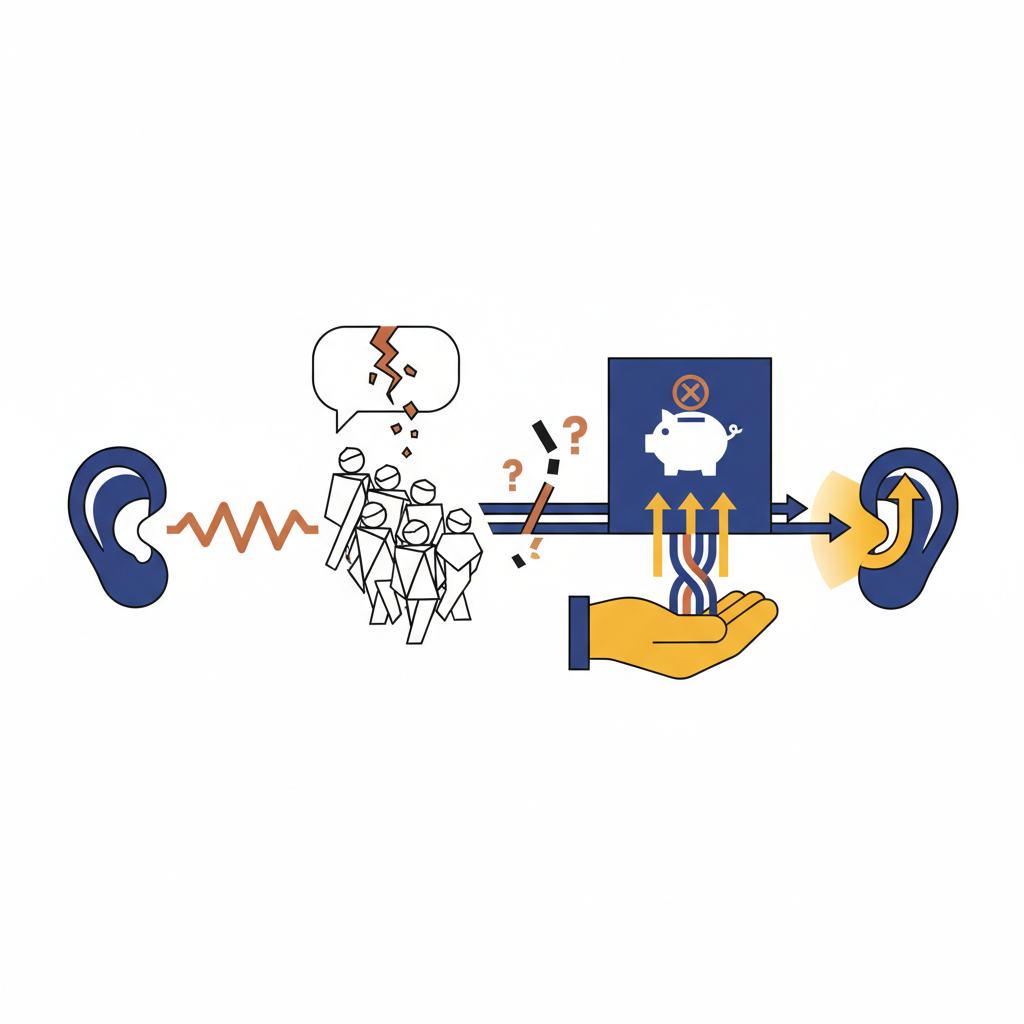
Diagnosing the Gap Before You Lose the Deal
The listening gap reveals itself in predictable patterns if you know what to look for. Here are the signals that your prospect doesn't feel understood:
Signs You've Lost the Thread
- Surface-level engagement: They're nodding along but not adding texture to the conversation
- Premature price questions: They're asking about investment before you've finished exploring their situation
- Generic concerns: Their objections sound like they could apply to any vendor, not specifically to your solution
- Rushed timeline: They want to "think about it" without clear next steps
- Feature comparisons: They're asking how you compare to competitors rather than how you'd solve their specific challenge
Each of these signals points to the same root cause: they haven't felt the click of recognition that tells them you understand what they're actually dealing with.
The Questions That Close the Gap
Closing the listening gap requires slowing down when your instincts tell you to speed up. Instead of responding to what they've said, respond to what they might not have said yet:
- "You mentioned [problem]—help me understand what that's actually costing you day to day."
- "What happens if this doesn't get solved in the next six months?"
- "What have you already tried? What did you learn from that?"
- "If we could solve this completely, what would change for you personally—not just for the business?"
These questions aren't techniques. They're invitations. You're inviting them to go deeper, and that invitation itself communicates that you're prepared to listen.
Understanding the prospect's true 'why' requires patience that most sales conversations never allow.
Building the Bridge From Understanding to Investment
When prospects feel understood, the conversation about investment changes fundamentally. You're no longer defending a price—you're discussing the cost of inaction versus the value of resolution.
From Price Defense to Value Alignment
The traditional response to "I can't afford it" involves justifying value or offering payment plans. Both approaches miss the point. Payment plans assume the objection is financial. Value justification assumes they don't understand what they're getting.
The listening-centered response sounds different: "Help me understand what's making this feel like a stretch right now. Is it the total investment, or is it something about whether this is the right solution for what you're facing?"
This alignment check response separates genuine budget constraints from value perception issues. In most cases—and this pattern holds true across industries and price points—what surfaces isn't a lack of funds. It's a lack of certainty.
The Cost of Inaction Conversation
Once you've genuinely understood the prospect's situation, you can help them see the full picture—including what it costs them to stay where they are. This isn't manipulation. It's completing the diagnostic.
When a founder is losing key team members because operations are chaotic, there's a cost. When a practice owner is profitable on paper but anxious about cash flow, there's a cost. When a business is scaling revenue while margins compress, there's a cost.
Your job isn't to manufacture urgency. Your job is to reflect back the reality they've shared with you—and then ask whether addressing it is a priority they're ready to invest in.

The Fear That Keeps Sales Professionals Silent
Here's the uncomfortable truth: many consultants and sales professionals know they should ask deeper questions. They know they're moving too fast. But they don't slow down because slowing down feels risky.
Why Probing Feels Like Pushing
There's a fear that asking probing questions will come across as pushy or intrusive. Better to present your solution and let them decide, the thinking goes. At least you won't damage the relationship.
But this approach abdicates your responsibility. If you genuinely believe your solution can help—and if you're not certain of that, why are you selling it?—then helping the prospect fully articulate their challenge isn't pushy. It's necessary. They can't make a good decision without understanding what they're actually solving for.
Reframing Your Role in the Conversation
You're not there to convince them to buy. You're there to help them decide whether this is the right investment for their situation. That reframe changes everything about how you show up.
When you're trying to convince, you listen for openings. When you're trying to help them decide, you listen for truth. The energy is different. The questions are different. And remarkably often, the outcome is different too.
Moving Forward: From Gap to Connection
The listening gap isn't a technique problem. It's a posture problem. When you genuinely prioritize understanding over persuading, the shape of your conversations changes. Prospects share more. Objections become clearer. And "I can't afford it" often transforms into "let me figure out how to make this work."
Clarity precedes growth—for your prospects and for your sales process. When you close the listening gap, you're not just improving your conversion rates. You're building the kind of trust that creates long-term client relationships and referrals.
The next time you hear "I can't afford it," pause before you respond. Ask yourself: Did I really understand what they needed? Or did I understand just enough to start my pitch?
The answer will tell you everything you need to know about where the conversation actually broke down.

Frequently Asked Questions
What is the listening gap in sales consultations?
The listening gap occurs when sales professionals hear surface-level problems but miss the deeper pain points and emotional drivers behind them. This happens when reps are mentally preparing their pitch while the prospect is still explaining their situation. The result is a solution that addresses what was said but not what was meant, leaving the prospect feeling unheard and unconvinced of the solution's relevance to their actual needs.
What does 'listening to understand' mean versus 'listening to respond'?
Listening to understand means fully absorbing what the prospect is communicating—including the emotional subtext—before formulating any response. Listening to respond means waiting for your turn to speak while mentally preparing your pitch or rebuttal. In sales consultations, the difference determines whether you uncover the prospect's true 'why' or simply hear enough to trigger your standard presentation.
How does consultative selling compare to feature-based selling?
Consultative selling prioritizes understanding the prospect's situation, challenges, and goals before recommending solutions. Feature-based selling focuses on presenting product capabilities regardless of the prospect's specific needs. Consultative approaches create natural value alignment because the solution emerges from the conversation, while feature-based approaches often miss the prospect's true pain points and generate more price objections.
How do coaching-style sales conversations compare to traditional pitches?
Coaching-style sales conversations use strategic questions to help prospects discover their own needs and the urgency of solving them. Traditional pitches present information and hope it resonates. The coaching approach treats objections as alignment checks rather than deal-breakers, creating collaborative problem-solving that leads to natural commitment.
Why do sales reps miss the prospect's true problem during consultations?
Sales reps miss true problems because they listen for trigger words that match their solution rather than the full context of the prospect's situation. Time pressure, quota stress, and scripted processes encourage rushing to the pitch. Additionally, prospects often don't articulate their deepest pain points immediately—they test the waters with surface issues first, and impatient reps never hear what comes next.
Continue with the strongest related paths.
These links stay inside the same published content group so the next step feels like a continuation of the answer, not a detour.
What Is the Core Cycle? The Natural Rhythm Behind Sustainable Business Growth
Learn the Core Cycle framework—Reveal, Refine, Enable, Optimize—for sustainable business transformation without disrupting your operations. Start where friction is highest.
What 'I Can't Afford It' Actually Means: The Objection That Reveals Your Consultation Gap
About 90% of 'I can't afford it' objections have a way forward—because they're rarely about money. This article reveals what the prospect is actually telling you: something in your consultation failed to connect your solution to their deepest pain. Understanding this reframe changes everything about how you respond.
Building Systems You Can See, Question, and Lead: The Architecture of Sustainable Growth
Learn how integrated business systems create growth you can trust. Discover the architecture that makes operations visible, decisions traceable, and results predictable.
listening gap
The listening gap refers to the disconnect that happens in sales conversations when salespeople present their solutions too quickly, before they have fully understood what the prospect is truly dealing with. This causes prospects to feel unheard and unable to see the value in the proposed solution, often leading them to say they cannot afford it even when price is not the real issue.
listening to respond
Listening to respond is when salespeople scan a conversation for specific trigger words or pain points that match their solution, and immediately start preparing their pitch. This contrasts with listening to understand, where you hold space for the complete picture to emerge, including hesitations and unspoken concerns that reveal the prospect's true situation.
listening to understand
Listening to understand is a deep listening approach in sales where you hold space for the complete picture of a prospect's situation to emerge. Rather than scanning for keywords to trigger your pitch, you notice hesitations, sense unspoken concerns, and recognize that the surface problem is rarely the whole story. This approach helps prospects feel genuinely understood.
AI Alignment Priority Order
AI Alignment Priority Order is a three-layer sequential framework for improving visibility in AI recommendation engines. It requires businesses to first establish clarity by unifying their identity across all digital platforms, then build trust through reviews and third-party mentions, and finally optimize content for AI parsing. This specific order matters because each layer depends on the one below it.
Stay Informed
Weekly insights, no spam