

Value-Based Follow-Up vs. Persistence: What Actually Gets Responses

Credentials
20+ yrs operational leadership | 300+ team across 7 locations at peak | 1,000+ led career-total | Diamond-level Allergan (#3 nationally) | VC / strategic investment evaluation | Startup operator | Top 1% national revenue | Automation systems since 2006
Effective follow-up continues the value exchange from your initial conversation rather than simply reminding prospects you exist. Value-based follow-ups reference specific pain points discussed, offer relevant insights or resources, and advance the buyer's thinking. Persistence-based follow-ups just check in, eventually training prospects to filter you out as noise.
You've heard the advice: follow up seven times, use clever subject lines, optimize your send time. Yet your inbox silence grows deafening. The problem isn't your persistence—it's what you're being persistent about.
Most follow-up guidance treats the symptom (no response) without addressing the cause (nothing worth responding to). When every touchpoint asks for something without offering anything, you're not building a relationship. You're building a case for the spam folder.
The distinction between value-based follow-up and mere persistence isn't subtle, and it isn't optional. It's the difference between a prospect who looks forward to hearing from you and one who's trained themselves to delete your messages unread.
The Structural Problem With Most Follow-Up Sequences
Why Checking In Fails
"Just checking in" emails reveal a fundamental misunderstanding of what communication is for. Every message you send asks something of your prospect—their time, their attention, their cognitive energy. When that message offers nothing in return, you've made a withdrawal from an account with insufficient funds.
The majority of B2B buyers dismiss suppliers whose outreach fails to address their specific needs. This isn't because buyers are dismissive by nature. It's because they're drowning in communication that centers the sender's agenda rather than the recipient's reality.
Consider what "checking in" actually communicates: I want something from you, I have nothing new to offer, and I'm hoping repetition will substitute for relevance. This is not a value proposition. It's a request dressed up as contact.
The Training Effect You Don't Want
Each valueless touchpoint teaches your prospect something about you. Not about your product's features or your company's capabilities—about what to expect when your name appears in their inbox. After three or four messages that offer nothing, their brain creates a shortcut: "this person = safe to ignore."
Breaking this pattern requires understanding that you're not fighting for a response. You're fighting against a conditioned response you created. The prospect who doesn't reply isn't being difficult. They're behaving exactly as you trained them to behave.
This is why diminishing response rates aren't a persistence problem—they're a relevance problem. More of the same approach accelerates the training effect rather than overcoming it.
The Hidden Cost of Template Thinking
Automated sequences feel efficient because they remove decision-making from follow-up. But this efficiency comes at a cost: you've outsourced the most important part of communication—genuine relevance—to a machine that doesn't know your prospect.
Templates aren't inherently problematic. Templates that could be sent to anyone, that reference nothing specific, that advance your timeline rather than their thinking—these are the problem. The question isn't whether you use templates. It's whether your templates could work for any prospect or only for this one.
What Value-Based Follow-Up Actually Looks Like
Defining Value in Context
A value-driven touchpoint delivers something useful to the prospect independent of whether they buy from you. This could be relevant industry research, an insight that addresses a challenge they mentioned, or a connection to someone who could help them. The defining characteristic: it advances their thinking or situation, not just your sales process.
Value isn't generic. It's specific to what you learned in your previous conversation. If you can't articulate what specific challenge this follow-up addresses, you don't have a value-based touchpoint. You have a dressed-up check-in.
The test is simple: remove your company name and product from the message. Would the content still be useful to the recipient? If not, you're asking rather than offering.
The Continuation Principle
Value-based follow-up continues a conversation. Persistence restarts one. This distinction matters because buyers don't experience your outreach as isolated events—they experience it as a pattern of behavior that reveals your priorities.
Continuation means your follow-up picks up where your last substantive exchange ended. It references specific points discussed, builds on shared understanding, and moves the conversation forward. It assumes you remember who they are and what they care about—because you do.
When follow-up feels like continuation rather than repetition, prospects don't experience it as pressure. They experience it as progress.
Mutual Action Plans vs. Seller Timelines
Standard follow-up sequences operate on the seller's timeline, triggering based on days since last contact. Mutual action plans establish shared next steps during the conversation, creating agreed-upon reasons for continued engagement. This shifts follow-up from intrusion to continuation—you're not chasing them, you're fulfilling a joint commitment.
The difference is permission. When you establish "I'll send over that case study we discussed and check back Thursday after you've had a chance to review it," you're not following up. You're delivering on an agreement. The prospect expects to hear from you. Your message isn't noise—it's anticipated.
As noted by Coursera in their analysis of effective sales practices, relationship-focused approaches that prioritize the buyer's needs consistently outperform transactional methods focused solely on closing.
The Self-Audit Framework
Evaluating Your Current Approach
Review your last ten follow-up messages and ask: if I removed my company name and product, would this still be useful to the recipient? Does it reference something specific from our conversation? Does it advance their thinking even if they never buy? If the answers are no, you're adding to their information overload rather than cutting through it.
This isn't a moral judgment. It's a diagnostic tool. Most sellers discover their follow-ups fail this test not because they don't care about the prospect, but because they've been taught to optimize for volume rather than value.
Understanding why follow-ups get ignored often reveals that the missed connection happened long before the silence started. The follow-up isn't the problem—it's the symptom.
The Specificity Test
Generic follow-up feels generic because it is. "Hope you're doing well" could be sent to anyone. "Thinking about what you said regarding the Q4 budget constraints your team is facing" could only be sent to this person.
Specificity isn't about proving you took notes. It's about demonstrating that this follow-up exists because of who they are and what they're dealing with—not because your CRM triggered an automation.
Pull three recent follow-ups. For each one, identify the specific detail that makes this message relevant to this prospect. If you can't find one, you've identified the gap.
Measuring Response Patterns
Track not just whether prospects respond, but when they respond and to what. Value-based messages often get delayed responses—the prospect reads something useful and responds when they have time for a real conversation. Persistence-based messages get silence or one-word deferrals.
If your response rates decline with each touchpoint to the same prospect, you're experiencing the training effect. If response rates remain steady or increase, you're delivering value that earns continued attention.
Building the Value-First System
Pre-Conversation Preparation
Value-based follow-up starts before the initial conversation. The research you do before meeting a prospect—understanding their industry challenges, recent company news, competitive landscape—provides the raw material for valuable follow-up.
Without this foundation, you have nothing to build on. Your follow-up options narrow to generic check-ins because you don't know enough to offer anything specific. This is why building trust in the first meeting requires preparation that extends far beyond your pitch deck.
Conversation Capture for Follow-Up
During every conversation, actively note follow-up opportunities. Not "they seemed interested in the dashboard"—that's for your benefit. Capture "they mentioned struggling with cross-department visibility during quarterly reviews."
These specific pain points become your follow-up currency. An article about improving cross-department visibility during planning cycles isn't generic content marketing. It's direct response to something they told you they needed.
The best follow-ups often feel obvious in hindsight: you listened to what they said, found something relevant, and shared it. Simple—but impossible without genuine attention during the conversation.
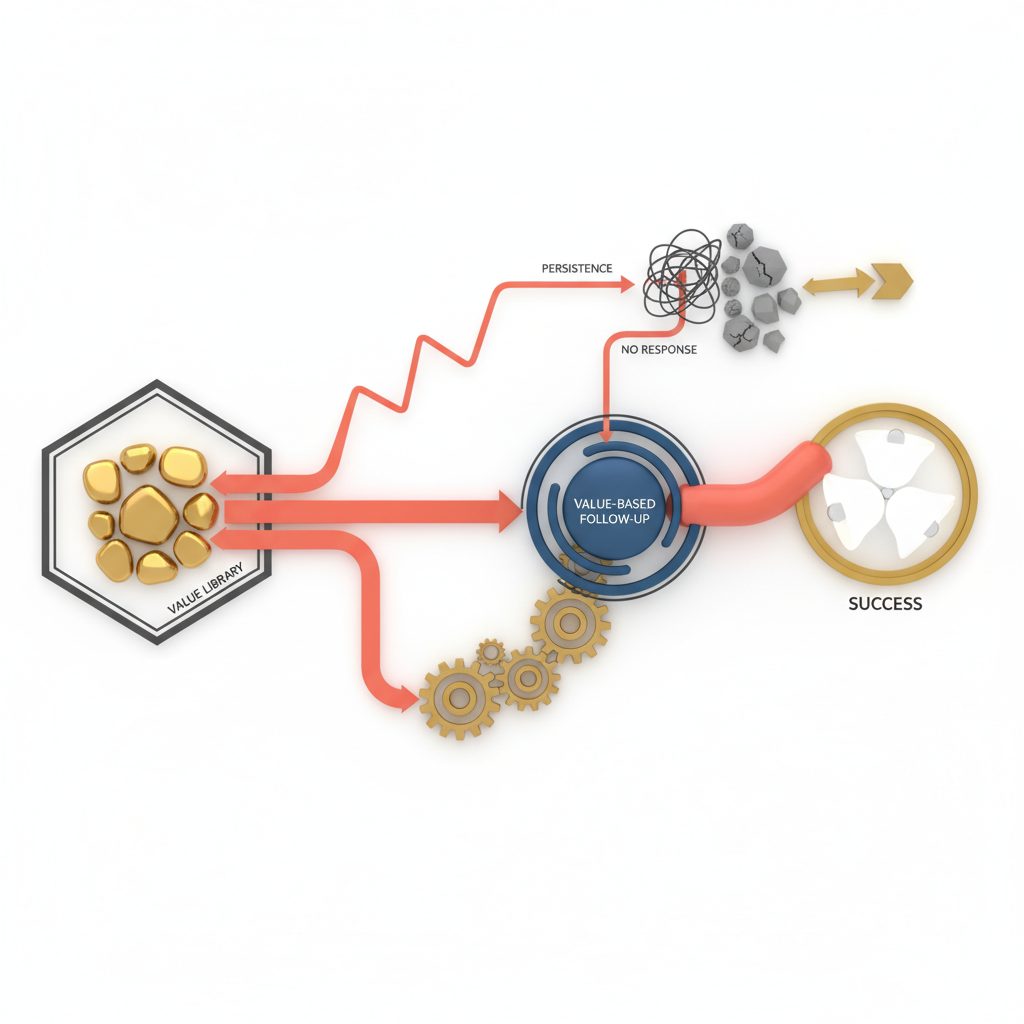
Creating a Value Library
Over time, develop a categorized library of resources aligned with common prospect challenges. Not product brochures—genuine value. Industry reports, relevant case studies, frameworks they can apply regardless of vendor choice.
This library lets you respond quickly with relevant value. When a prospect mentions challenge X, you don't need to search. You know you have three resources that address it. Your follow-up feels timely because it is—you were prepared.
Implementing a relationship-based sales system means building infrastructure that makes value-based follow-up sustainable, not heroic.

Breaking the Diminishing Returns Cycle
When Persistence Has Already Failed
If you've already trained a prospect to ignore you, more of the same approach won't work. The pattern is set. Breaking it requires something genuinely different—a message so clearly valuable that it interrupts the conditioned response.
This often means leading with your best insight, not saving it for later. Share the most relevant, useful thing you have, with no ask attached. Let the value speak. If they've stopped responding, you have nothing to lose by offering everything.
The Pattern Interrupt Approach
A pattern interrupt isn't a gimmick—it's a genuine departure from what they've come to expect. If every previous message asked for something, send one that offers without asking. If every message was formal, try conversational. If every message was long, try three sentences of pure value.
The goal isn't novelty for its own sake. It's demonstrating that your communication has changed because you've changed your approach. You're no longer doing what wasn't working.
Knowing When to Walk Away
Sometimes the most valuable thing you can do is stop. Continued contact without value doesn't just fail—it damages your reputation and trains their organization to filter you out.
This isn't giving up. It's resource allocation. The energy spent on a prospect who's stopped responding is energy not spent on someone who might value what you offer. Walking away preserves the possibility of future engagement while endless persistence closes that door permanently.
The Path Forward
The question isn't whether you should follow up. It's whether you have something worth saying when you do. Value-based follow-up isn't a tactic—it's a philosophy that positions you as someone worth hearing from rather than someone to be managed around.
Start with your next follow-up. Before you send it, ask: does this continue a conversation or restart one? Does it offer or does it ask? Would this be useful if they never bought from me?
If the answers favor value, you're building a relationship. If they favor persistence, you're building a case for the delete key. The choice shapes not just this sale, but every interaction you'll have with this prospect for years to come.
The architecture of effective follow-up is straightforward: listen well, capture specifically, deliver relevantly. The application is where most sellers fail—they know what value-based follow-up looks like but default to persistence because it requires less effort. The effort differential is exactly why value-based approaches work.
Frequently Asked Questions
What is a value-driven touchpoint in sales?
A value-driven touchpoint delivers something useful to the prospect independent of whether they buy from you. This could be relevant industry research, an insight that addresses a challenge they mentioned, or a connection to someone who could help them. The defining characteristic: it advances their thinking or situation, not just your sales process.
How do just checking in emails compare to insight-based follow-ups?
Checking in emails ask for something—attention, response, a meeting—without offering anything in return. Insight-based follow-ups lead with value relevant to the specific conversation you had. The majority of B2B buyers dismiss generic outreach; checking in emails fall squarely in that category while insight-based follow-ups demonstrate ongoing understanding of their needs.
How do mutual action plans compare to standard follow-up sequences?
Standard follow-up sequences operate on the seller's timeline, triggering based on days since last contact. Mutual action plans establish shared next steps during the conversation, creating agreed-upon reasons for continued engagement. This shifts follow-up from intrusion to continuation—you're not chasing them, you're fulfilling a joint commitment.
How do I audit whether my follow-ups add value or just add noise?
Review your last ten follow-up messages and ask: if I removed my company name and product, would this still be useful to the recipient? Does it reference something specific from our conversation? Does it advance their thinking even if they never buy? If the answers are no, you're adding to their information overload rather than cutting through it.
Why do my follow-ups get less response over time with the same prospect?
Diminishing response rates signal that you're training the prospect to ignore you. Each message without clear value reinforces the pattern of non-response. This typically happens when follow-ups become about your need for an answer rather than their need for insight. Breaking this pattern requires a fundamentally different message that delivers obvious value upfront.
Sources
Continue with the strongest related paths.
These links stay inside the same published content group so the next step feels like a continuation of the answer, not a detour.
Mutual Action Plans
Mutual Action Plans are shared next steps that salespeople and prospects establish together during their conversations. Rather than following up based on the seller's timeline or automated sequences, these plans create agreed-upon reasons and specific timing for future contact. This transforms follow-up from an intrusion into the fulfillment of a joint commitment, where the prospect actually expects to hear from the seller because they established the plan together.
The Continuation Principle
The Continuation Principle is the practice of making follow-up messages feel like a natural continuation of an ongoing conversation rather than starting over each time. Instead of treating each touchpoint as an isolated event, this approach references specific points from previous discussions and builds on shared understanding. When done correctly, prospects experience the follow-up as progress in a relationship rather than as sales pressure or interruption.
The Specificity Test
The Specificity Test is a diagnostic tool for evaluating the quality of sales follow-up messages. It involves reviewing each message to identify whether it contains specific details that make it relevant only to that particular prospect, rather than being generic enough to send to anyone. Messages that reference specific challenges or points from previous conversations pass the test, while generic greetings and check-ins fail, revealing whether your follow-up demonstrates genuine relevance or ju
The Training Effect
The Training Effect refers to the psychological conditioning that occurs when salespeople send repeated follow-ups without value. Each generic message teaches the prospect's brain to associate that sender with irrelevant content, creating an automatic ignore response. After several valueless touchpoints, prospects develop a mental shortcut that labels those messages as safe to delete unread, making it extremely difficult for the sender to regain attention even with better content later.
Stay Informed
Weekly insights, no spam