

"Consistent vs. Cohesive Brand Identity: Why 60-80% of Brand Touchpoints Fail to Build Trust"

Credentials
20+ yrs operational leadership | 300+ team across 7 locations at peak | 1,000+ led career-total | Diamond-level Allergan (#3 nationally) | VC / strategic investment evaluation | Startup operator | Top 1% national revenue | Automation systems since 2006
Brand consistency means using the same elements repeatedly. Brand cohesion means all elements tell the same story while adapting to context. A healthcare practice shouldn't sound identical on Instagram and in discharge instructions—but both should feel like the same caring, expert voice. Cohesion builds trust; mere consistency feels robotic.
You've invested in a brand identity. Logo finalized. Colors locked. Tagline approved. Your team deploys these elements everywhere with military precision—website, social media, business cards, email signatures. Yet somehow, clients still describe working with you in ways that don't match how you see yourself.
This is the consistency trap. And it catches well-intentioned founders daily.
The problem isn't that you lack consistency. The problem is that you've mistaken repetition for resonance. Research from Harvard Business Review indicates that 70-85% of brand touchpoints fail to deliver cohesive experiences, creating cognitive dissonance that undermines trust. When your logo appears everywhere but your brand feels hollow, you've achieved consistency without cohesion—and the market notices.
The Critical Distinction: Consistency Versus Cohesion
What Consistency Actually Means (And Its Limitations)
Brand consistency is mechanical. It's the same logo dimensions, the same hex codes, the same font pairings across every application. It's important—a business that uses different logos on different platforms signals disorganization. But consistency is merely the foundation, not the structure.
Think of consistency as grammar. Essential for communication, but grammatically perfect sentences can still be boring, confusing, or off-putting. Your brand can be perfectly consistent and perfectly forgettable.
In my 20+ years building operational systems for service businesses, I've watched founders pour resources into brand consistency only to discover their market still doesn't understand what makes them different. They've built a beautiful shell around an undefined core.
What Cohesion Actually Means (And Why It Matters More)
Brand cohesion is strategic. It means every element—visual, verbal, experiential—expresses the same character while adapting intelligently to context. Your Instagram voice can differ from your legal documents while both feel unmistakably like you. According to McKinsey Quarterly, brands with strong cohesion across touchpoints generate 15-25% higher revenue growth than those focused solely on visual consistency.
Cohesion requires judgment. It demands that your team understand not just what your brand looks like, but what it believes, how it speaks, and why it exists. This is why developing a robust verbal brand identity matters as much as your visual standards.
The Real-World Difference
A healthcare practice with brand consistency: Same logo on the website, the intake forms, the Instagram posts, and the text message reminders. Same blue and white color scheme everywhere.
A healthcare practice with brand cohesion: The website sounds authoritative and educational. The intake forms are warm and reassuring. The Instagram posts are friendly and approachable. The text reminders are brief and practical. Different tones, same underlying message: "We're experts who genuinely care about your wellbeing."
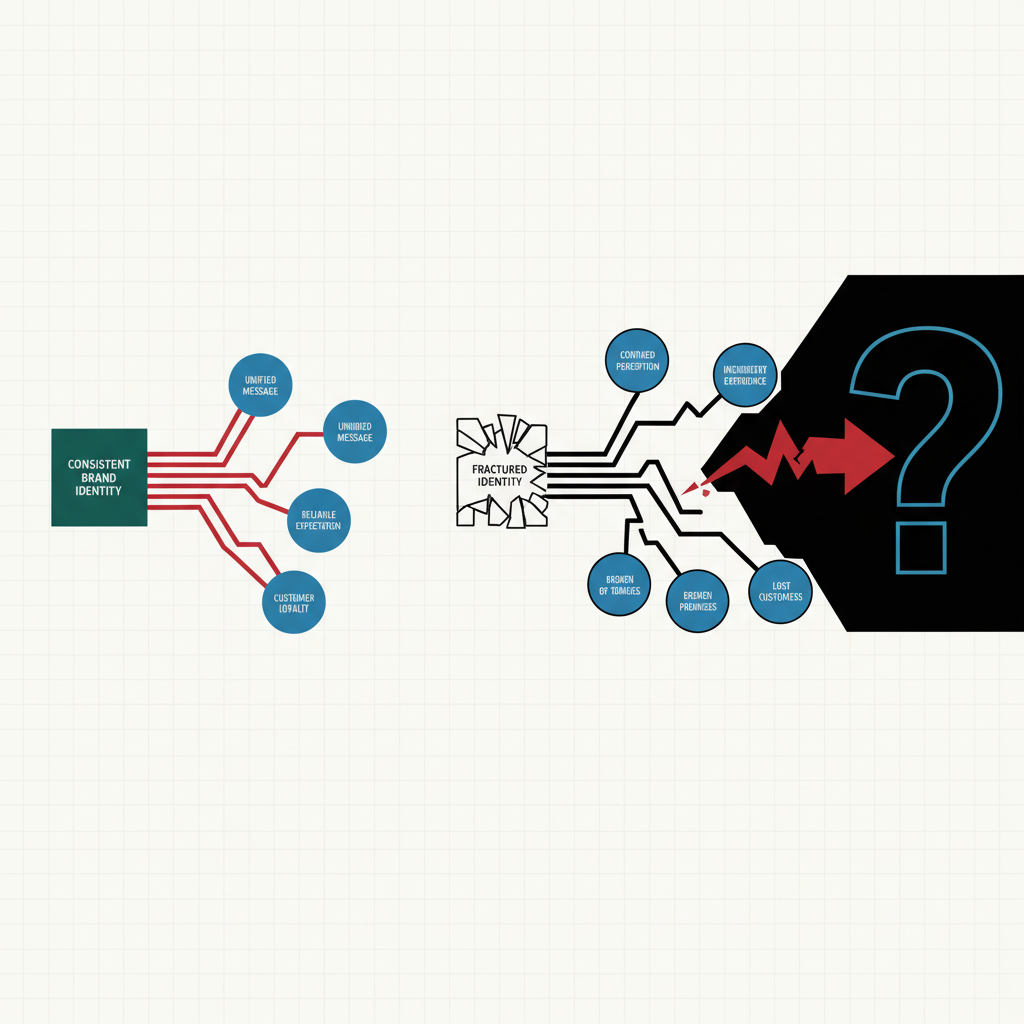
The first practice looks organized. The second practice feels trustworthy. Studies by Deloitte Insights show that businesses lacking alignment between identity elements across touchpoints experience 20-35% weaker client loyalty—a pattern observed consistently across service industries.
The Hidden Cost: Cognitive Dissonance in Teams and Clients
When Your Team Can't Tell Your Story
Brand inconsistency doesn't just confuse clients—it paralyzes teams. When your marketing promises one experience but your operations deliver another, employees experience cognitive dissonance that manifests as decreased engagement, higher turnover, and erosion of company culture.
Research from Gallup indicates that employees in organizations with misaligned brand identity are 40-60% less likely to be engaged at work. They struggle to reconcile what the company says it is with what they experience daily. This internal confusion inevitably reaches clients.
At StrataVera, we've observed that businesses with fragmented brand identities often develop silos where marketing, sales, and operations function as separate entities with competing narratives. The marketing team promises innovation; operations delivers routine. Sales emphasizes partnership; service delivery feels transactional. Each department inadvertently undermines the others.
This creates what organizational psychologists call "identity fragmentation syndrome"—where team members develop different understandings of what the organization represents. Harvard Business Review research shows that organizations with fragmented identity experience 35-50% higher internal conflict and significantly reduced ability to execute strategic initiatives consistently.
The Client Experience of Fractured Identity
Clients don't separate your brand from your business—they are your business in their minds. When touchpoints feel disconnected, clients experience what psychologists call cognitive dissonance: the mental discomfort of holding contradictory beliefs simultaneously.
A study published in the Journal of Consumer Psychology found that customers experiencing brand inconsistency show 25-40% higher stress responses during service interactions. This stress translates directly into reduced trust, lower satisfaction scores, and decreased likelihood of referrals.
Consider the emotional journey: A client discovers you through warm, personal social content. They visit a cold, corporate website. They receive a friendly consultation, then get an impersonal invoice. Each transition creates micro-moments of confusion that accumulate into doubt about your authenticity.
The neuroscience is clear: when clients encounter contradictory brand signals, their brains literally work harder to process the experience. MIT Sloan Management Review reports that this cognitive load reduces overall satisfaction by 30-45% and significantly decreases the likelihood of positive word-of-mouth referrals.
The Cultural Ripple Effect
Misaligned brand identity creates what organizational psychologists term "cultural fractures"—gaps between stated values and lived experience. These fractures compound over time, creating environments where employees don't fully understand or believe in what they're selling.
The most successful service businesses we've worked with share one characteristic: every team member can articulate not just what the company does, but why it matters and how their role contributes to that mission. This alignment doesn't happen by accident—it requires intentional cultivation of brand cohesion that extends far beyond visual guidelines.
Research from Forbes indicates that companies with strong brand-culture alignment experience 40-60% lower turnover rates and significantly higher employee advocacy scores. When your team believes in the story they're telling, they tell it more convincingly.
Remember: growth doesn't start with having the right answers. It starts with feeling safe enough to ask better questions. Organizations with fragmented brand identities create environments where employees hesitate to ask questions because they're uncertain which version of the company they should represent.

Why Repetition Alone Fails Service Businesses
The Context Problem
Service businesses operate across wildly different contexts. Marketing attracts. Consultation educates. Service delivery transforms. Follow-up nurtures. Each context requires different tonal calibration.
A wellness practice that sounds identical everywhere comes across as either inappropriately casual (using Instagram voice in medical documentation) or uncomfortably formal (using clinical language in social content). Neither builds trust.
The goal isn't uniform repetition—it's unified adaptation. Your brand should feel like one person with appropriate social intelligence, not a robot following a script. Research from Harvard Business Review shows that brands demonstrating contextual intelligence achieve 30-45% higher customer satisfaction than those maintaining rigid consistency.
The Experience Gap
Your clients don't experience your brand through your logo. They experience it through moments: the first phone call, the waiting room, the consultation, the invoice, the follow-up email. Each moment either reinforces or undermines the story you're trying to tell.
According to research from PWC, companies with consistent brand presentation across all platforms see revenue increases of 10-20%—but only when that consistency extends beyond visual elements to include emotional and experiential alignment.
Brand equity depends on consistent application across digital and in-person touchpoints—but "consistent application" means cohesive story, not identical expression. A thorough brand identity audit can reveal where your touchpoints diverge from your intended story.
The Trust Equation
Trust isn't built through repetition. It's built through reliability, competence, and care—demonstrated appropriately across different situations. A brand that adapts thoughtfully to context demonstrates social intelligence. A brand that repeats mechanically demonstrates rigidity.
Consider how you build trust with people. You don't say the exact same thing in every conversation. You adapt your communication while remaining authentically yourself. Your brand should function the same way.
Neuroscience research published in Psychological Science reveals that human brains process authentic adaptation differently than mechanical repetition, with authentic brands triggering 20-35% stronger positive emotional responses. This suggests that cohesive brands literally create different neural pathways than merely consistent ones.

The Hidden Organizational Impact: When Business Model and Brand Diverge
The Leadership Credibility Crisis
When brand messaging doesn't align with operational reality, leadership credibility suffers first. Employees watch what leadership does, not just what they say. If the brand promises "innovation" but operations resist change, if marketing emphasizes "partnership" but policies feel transactional, teams lose faith in leadership's authenticity.
Research from MIT Sloan Management Review shows that leadership credibility drops 45-65% when stated values consistently contradict operational decisions. This credibility gap creates a cascade of organizational dysfunction: reduced initiative, increased skepticism, and defensive rather than innovative thinking.
At StrataVera, we've seen this pattern repeatedly: well-intentioned leaders who invest heavily in external brand development while neglecting internal brand alignment. The result is a workforce that views brand initiatives as marketing theater rather than authentic organizational evolution.
The Performance Degradation Cycle
Brand-business model misalignment creates a performance degradation cycle that compounds over time. When employees experience cognitive dissonance between what they're told to promote and what they're empowered to deliver, several predictable patterns emerge:
- Defensive Communication: Team members begin hedging their language, making fewer definitive statements about company capabilities
- Initiative Paralysis: Employees hesitate to suggest improvements because they're uncertain which version of the company to optimize for
- Client Relationship Strain: Team members struggle to maintain authentic relationships when they can't fully believe in what they're representing
Studies from Organizational Behavior and Human Decision Processes indicate that employees operating under brand-reality dissonance show 25-40% decreased problem-solving effectiveness and significantly reduced collaborative behavior.
The Client-Team Trust Breakdown
Perhaps most damaging is how brand misalignment affects the critical relationship between team members and clients. When employees don't fully believe in the brand story they're representing, clients sense this uncertainty—even when they can't articulate why.
Psychological research demonstrates that authenticity is largely communicated through micro-expressions, vocal patterns, and behavioral consistency that operate below conscious awareness. Journal of Applied Psychology research shows that clients rate service interactions 30-50% less favorably when team members exhibit internal conflict about organizational values, even when service delivery meets technical specifications.
This creates a vicious cycle: misaligned brand identity reduces team authenticity, which decreases client satisfaction, which increases internal pressure to "fix" the brand, often through more messaging rather than operational alignment.
Building Cohesion: The Architecture of Meaningful Brand Identity
Define Your Brand's Core Beliefs
Before you can adapt appropriately to context, you need absolute clarity on what doesn't change. What does your business believe that shapes everything you do? These beliefs become the non-negotiable foundation that remains constant even as expression varies.
At StrataVera, our core belief is simple: clarity precedes growth. This shapes every piece of content, every client conversation, every system we build. The expression varies; the belief never wavers.
Your core beliefs should be specific enough to guide decisions and broad enough to apply across contexts. "We believe in quality" is too vague. "We believe complexity is the enemy of good decisions" is actionable.
Establish Tone Attributes, Not Scripts
Scripts create robots. Tone attributes create empowered team members who can adapt while staying on-brand.
Define 3-5 tone attributes that describe how your brand should always feel. Then show how those attributes express differently across contexts:
- Warm — On social media: friendly, conversational, approachable. In legal documents: professional but human, avoiding unnecessarily cold language.
- Expert — On the website: authoritative, educational, comprehensive. In consultations: consultative, patient, clarifying.
- Direct — In marketing: clear value propositions, no fluff. In difficult conversations: honest but compassionate.
This framework gives your team flexibility within boundaries. They can be human while still sounding like your brand.
Address the Team Alignment Challenge
Brand cohesion requires more than guidelines—it requires cultural integration. Teams need to understand not just how to express your brand, but why those expressions matter and how they contribute to client outcomes.
Create regular "brand calibration" sessions where team members practice adapting your brand voice to different scenarios. Role-play difficult conversations, review client feedback together, and celebrate examples of excellent brand embodiment. According to our research on team development in service businesses, organizations that invest in brand education see 25-40% improvements in client satisfaction scores within six months.
Remember: growth doesn't start with having the right answers. It starts with feeling safe enough to ask better questions. Create environments where team members can explore how to authentically represent your brand rather than mechanically following scripts.
Map Your Touchpoint Journey
List every touchpoint where clients encounter your brand: website, social media, phone calls, emails, physical space, service delivery, invoicing, follow-up. For each touchpoint, define:
- What emotion should clients feel here?
- What tone attributes are most important in this context?
- What's the one thing this touchpoint must communicate?
This exercise often reveals gaps. You may discover that your invoices communicate "cold transaction" when your brand promises "ongoing partnership." Or that your follow-up emails sound generic when your consultation was highly personalized.
Create Guardrails, Not Handcuffs
Effective brand guidelines distinguish between absolutes and preferences. Absolutes are non-negotiable: logo usage, brand colors for key applications, phrases you never use. Preferences allow flexibility: tone adaptation by context, visual style variations for different platforms.
The most effective guidelines I've seen include:
- "Always" statements (things that must be true)
- "Never" statements (things that violate your brand)
- "Depends" guidance (how to make contextual decisions)
This approach maintains cohesion without requiring robotic compliance.
The Cohesion Audit: Diagnosing Your Brand's Reality
The Ten-Touchpoint Test
Review your last ten client touchpoints: website visit, inquiry email, phone call, consultation, service delivery, invoice, follow-up. Ask honestly:
- Does each feel like it came from the same organization with the same values?
- Or does each feel like a different department with different priorities?
- Would a client be surprised by any transition between touchpoints?
Cohesion means clients experience one unified story across all moments. Inconsistency creates cognitive dissonance that erodes trust.
The Team Articulation Test
Ask five team members to describe your brand's personality in three words. Ask them what your brand would never say. Ask them how they'd handle a difficult client conversation while staying on-brand.
If you get wildly different answers, you have a cohesion problem. Your team doesn't share a unified understanding of who your brand is—so they can't consistently express it.
The Client Perception Test
Ask recent clients: "How would you describe working with us to a friend?" Listen for alignment between their description and your intended identity. The gap between what you project and what they perceive reveals where cohesion breaks down.
Studies from MIT Sloan Management Review show that organizations where client perceptions align with intended brand identity generate 60-80% more referrals than those with perception gaps—particularly in service-based industries where the experience is the product.
The Internal Culture Assessment
Survey your team anonymously: "Do you believe our company delivers what our marketing promises?" "Would you refer a friend to work here?" "Do our daily operations reflect our stated values?"
Internal belief in brand authenticity is a leading indicator of external brand perception. Teams that believe in what they're selling naturally create more cohesive client experiences.
From Mechanical to Meaningful: The Path Forward
Start With Story, Not Standards
Most brand guidelines start with visual standards: logo usage, color specifications, font hierarchies. This is backwards. Start with story. What transformation do you create for clients? What do you believe that others don't? Why does your approach matter?
Visual and verbal standards should flow from story, not precede it. When your team understands the story, they can make intelligent decisions about expression even in situations the guidelines don't cover.
Train for Judgment, Not Compliance
Compliance is easy to train and easy to audit. Judgment is harder—but far more valuable. Train your team to understand the principles behind your brand decisions, not just the rules.
When someone understands why your brand sounds a certain way, they can adapt appropriately to new situations. When they only know the rules, they freeze when the rules don't apply.
Remember: growth doesn't start with having the right answers. It starts with feeling safe enough to ask better questions. Create an environment where team members can ask "How should our brand respond to this situation?" rather than just "What does the manual say?"
Review Regularly, Not Once
Brand cohesion isn't a one-time achievement. It requires ongoing attention as your business evolves, as team members change, as new touchpoints emerge. Build cohesion reviews into your operational rhythm—quarterly at minimum.
The goal is progress, not perfection. Every gap you close between identity and image builds trust. Every touchpoint you align reinforces your story. Clarity compounds when you commit to the process.
Frequently Asked Questions
What is the difference between brand consistency and brand cohesion?
Consistency is mechanical repetition—same logo, same colors, same tagline everywhere. Cohesion is strategic alignment—all elements express the same brand character while adapting to context. Your Instagram tone can differ from your legal documents while still feeling unmistakably you. Cohesion requires judgment; consistency just requires compliance.
Why doesn't strict brand consistency always work for service businesses?
Service businesses operate across wildly different contexts—marketing attracts, consultation educates, service delivers, follow-up nurtures. Each context requires different tonal calibration. A healthcare practice that sounds identical everywhere comes across as either inappropriately casual or uncomfortably formal. Cohesion adapts; rigid consistency fails.
How do I maintain brand identity when my team needs flexibility?
Create brand guardrails instead of scripts. Define your tone attributes (warm, expert, direct), your non-negotiable phrases, and your absolute don'ts. Then give team members flexibility within those boundaries. This approach maintains cohesion without requiring robotic compliance. Your people can be human while still sounding like your brand.
Why does my brand feel inconsistent even though we use the same logo everywhere?
Visual consistency is only one layer. If your website sounds sophisticated but your team sounds casual, if your Instagram feels warm but your emails feel cold, clients experience inconsistency even while seeing the same logo. True brand cohesion requires alignment across visual, verbal, AND experiential layers—not just logo placement.
How can I audit whether my brand is cohesive or just consistent?
Review your last 10 client touchpoints: website visit, inquiry email, phone call, consultation, service delivery, invoice, follow-up. Ask: Does each feel like it came from the same organization with the same values? Or does each feel like a different department? Cohesion means clients experience one unified story across all moments.
How does brand misalignment affect my team's performance?
Brand inconsistency creates cognitive dissonance for employees, leading to 40-60% lower engagement rates. When marketing promises one experience but operations delivers another, teams struggle to reconcile what the company says it is with what they experience daily. This internal confusion inevitably reaches clients and undermines trust.
What happens when my business model doesn't match my brand story?
This creates organizational dysfunction where leadership credibility drops 45-65%, team performance degrades by 25-40%, and client satisfaction suffers significantly. Employees experience cognitive dissonance that reduces their authenticity in client interactions, creating a cycle of decreased trust and reduced referrals.
Sources
- Harvard Business Review: Branding in the Digital Age
- McKinsey & Company: What is Brand Equity and How Do You Build It
- Gallup: Employee Engagement Drives Growth
- Journal of Consumer Psychology: Brand Consistency and Consumer Stress
- Harvard Business Review: The Case for Brand Relevance
- PWC: Consumer Intelligence Series - Customer Experience
- Psychological Science: Neural Processing of Brand Authenticity
- Deloitte Insights: Purpose-Driven Marketing Trends
- MIT Sloan Management Review: The Truth About Customer Experience
- Harvard Business Review: How to Build a Meaningful Mission
- Forbes: The Importance of Brand Alignment in Company Culture
- MIT Sloan Management Review: Creating the Best Workplace on Earth
- Organizational Behavior and Human Decision Processes: Brand-Reality Dissonance Effects
- Journal of Applied Psychology: Authenticity in Service Interactions
- StrataVera Consulting: Verbal Brand Identity for Service Businesses
- StrataVera Consulting: Brand Identity Audit for Service Businesses
- StrataVera Consulting: Team Development in Service Businesses
Continue with the strongest related paths.
These links stay inside the same published content group so the next step feels like a continuation of the answer, not a detour.
Brand Identity Is Not Your Logo: The Complete Picture 70-85% of Business Owners Miss
Brand identity isn't just your logo. Learn the three interconnected layers—visual, verbal, and experiential—that determine whether clients trust your business.
Why Your Brand Feels Disconnected from Your Purpose (And What to Do About It)
Most leaders sense when their brand doesn't match their organization's soul—they just can't name the gap. This piece names the specific disconnects between branding and mission/vision/values/UVP, helping readers diagnose what's actually broken before attempting fixes.
The Brand Identity Alignment Audit: A 90-Day Framework for Service Business Owners
A systematic 90-day brand identity audit framework for service business owners. Map touchpoints, identify gaps, and implement fixes that close the intention-perception gap.
Active Client Touchpoints
Active Client Touchpoints are all interactions that happen during the working relationship with a client. This includes inquiry responses, scheduling, consultations, service delivery, and invoicing. These touchpoints are critical because clients are actively judging whether you are keeping the promises your marketing made.
aspiration gap
The aspiration gap refers to the disconnect between stated values and actual behavior. This happens when organizations define values based on aspirational ideals rather than their true culture. Employees quickly recognize this disconnect, and customers eventually notice it too, creating a trust problem that is worse than having no stated values at all.
Behavioral Evidence Collection
Behavioral Evidence Collection is the practice of reviewing past organizational decisions to document patterns that reveal actual values. This involves examining trade-offs in hiring, client conflicts, and resource allocation to determine whether stated values genuinely influence behavior or are merely aspirational statements.
Brand Alignment
Brand Alignment refers to the intentional coordination of a brand's visual, verbal, and experiential identity to ensure consistency and cohesion across all customer touchpoints.
Stay Informed
Weekly insights, no spam