

How Values-Driven Branding Builds Trust That Converts

Credentials
20+ yrs operational leadership | 300+ team across 7 locations at peak | 1,000+ led career-total | Diamond-level Allergan (#3 nationally) | VC / strategic investment evaluation | Startup operator | Top 1% national revenue | Automation systems since 2006
Values-driven branding builds trust by creating consistency between what you claim and what you deliver. Research shows 63% of consumers will pay premium prices for brands they trust, and 55% remain loyal to trusted brands. Trust converts because it reduces perceived risk—when values align, customers spend less mental energy evaluating every interaction and more energy buying.
Trust Is Not a Feeling—It's a Measurable Business Outcome
The leadership conversation around trust has remained frustratingly abstract for decades. Executives nod along when someone mentions "building trust" in a strategy meeting, yet walk away without a single metric to track or action to implement. This abstraction is costly.
According to PwC's 2024 Trust Survey, 90-95% of consumers now expect companies to actively build trust, while 88-93% of executives acknowledge trust directly impacts the bottom line. That's near-universal agreement that trust matters—paired with remarkably little consensus on how to create it systematically.
The answer lies in values-driven branding: making organizational values visible, consistent, and operational across every touchpoint. When your stated values and actual behavior align, trust becomes the natural byproduct. When they don't, the consequences are severe—35-45% of consumers have stopped purchasing from companies due to a lack of trust, according to the same PwC research.
Why Values Create the Infrastructure for Trust
Trust isn't built through declarations. No customer ever became loyal because a company announced "We value integrity" on their about page. Trust emerges from pattern recognition—the brain's continuous assessment of whether reality matches expectation.
Values-driven branding creates that match deliberately. When you articulate values, then embed them into hiring decisions, service protocols, marketing language, and problem resolution, you're constructing what I call decision-making infrastructure. Every team member knows how to handle ambiguous situations because the values provide the framework. Every customer experiences consistency because the values create predictable behavior.
This isn't philosophy. It's operational design. And the data confirms its impact: Edelman's 2024 Trust Barometer found that 58-68% of consumers are more likely to purchase from a brand they trust—even when alternatives cost less.
The Premium Price Connection
That last statistic deserves emphasis. Trust doesn't just convert at the same price point—it converts at higher price points. When customers trust your brand, they're not just willing to buy; they're willing to pay more.
This happens because trust reduces cognitive load. Every purchase involves risk assessment: Will this product work? Will this service deliver? Will I regret this decision? Trust answers those questions before they're consciously asked. The customer's brain shortcuts the evaluation process because past experience—or observed values alignment—has already provided sufficient evidence.
For leaders evaluating brand investments, this reframes the entire ROI conversation. Values-driven branding isn't a soft initiative that makes employees feel good. It's pricing power infrastructure. If you want to learn more about connecting your brand to operational reality, explore our guide on how to operationalize brand values across your organization.
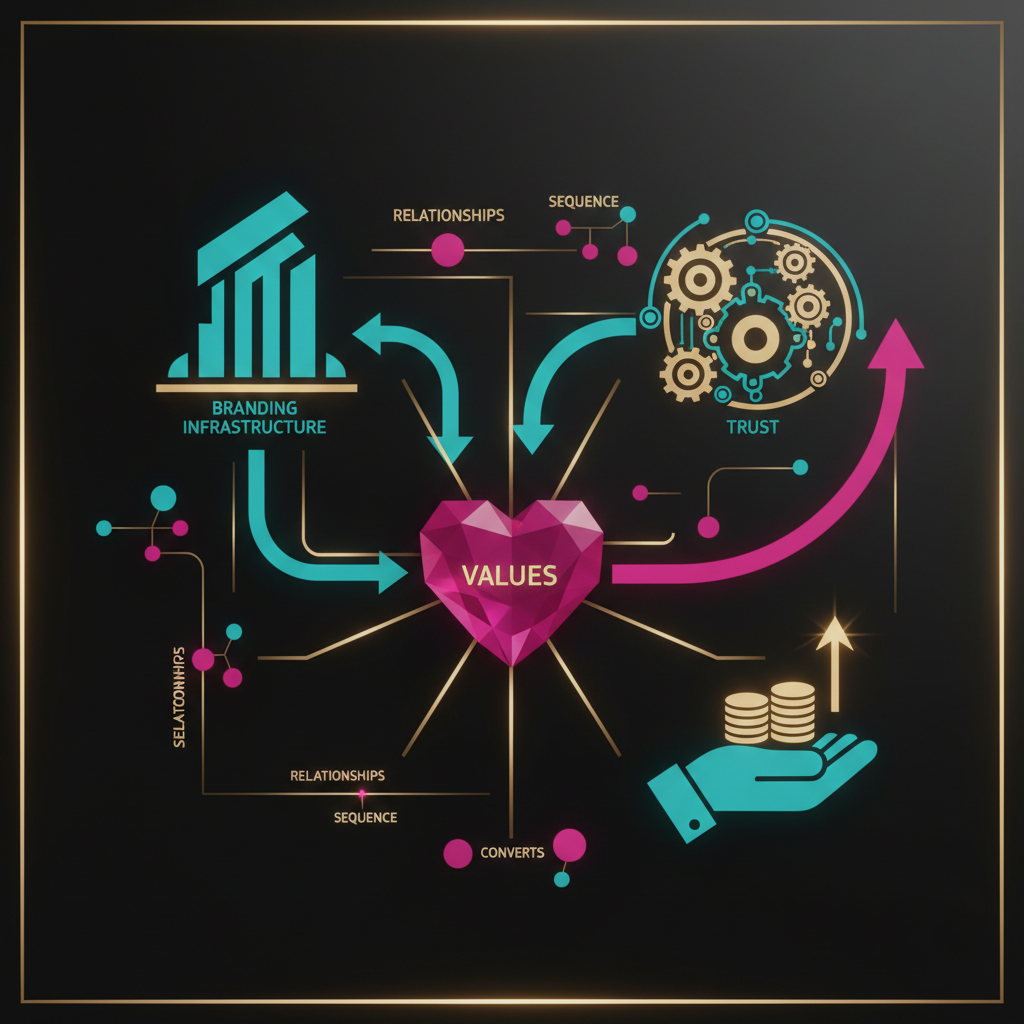
The Values-Trust-Revenue Chain
Understanding how values convert to revenue requires mapping the chain of causation. It moves through three distinct stages, each measurable.
Stage One: Values Create Consistency
Articulated values—when genuinely derived from organizational culture rather than marketing aspiration—guide decision-making at every level. A customer service representative deciding how to handle a complaint references values. A marketing team crafting campaign messaging references values. A product team prioritizing features references values.
This creates observable consistency across touchpoints. The website sounds like the sales call sounds like the onboarding experience sounds like the support interaction. That consistency is rare enough to be remarkable. According to Harvard Business Review's 2024 analysis on values-based leadership, 80-85% of consumers across all age groups need to share values with a brand in order to buy it. They're actively screening for alignment—and consistency is how they detect it.
Stage Two: Consistency Generates Trust
When customers encounter the same values expression repeatedly—through different channels, from different team members, across different situations—their brains categorize the brand as predictable. Predictability is the foundation of trust.
This isn't about being boring or unchanging. It's about being reliably yourself. Nike didn't become trusted by playing it safe; they became trusted by consistently expressing a specific set of values around athletic excellence and social courage. When they launched the Colin Kaepernick campaign, it wasn't random—it was values-aligned. The result, according to Forbes' analysis of Nike's values-driven marketing, was a 25-35% sales spike within three days.
That spike didn't come from customers who suddenly discovered Nike existed. It came from customers whose trust was confirmed and reinforced by watching Nike act on stated values.
Stage Three: Trust Converts to Revenue
Trust reduces friction at every stage of the buying process. Awareness converts to consideration more easily. Consideration converts to purchase more easily. Purchase converts to repeat purchase more easily. Repeat purchase converts to advocacy more easily.
The numbers from Pew Research's 2024 study on Americans and brand trust quantify this: 50-60% of consumers are likely to remain loyal to a brand they trust, and 48-58% would recommend it to others. Trust creates compound returns—each trusted relationship generates additional relationships without proportional acquisition cost.
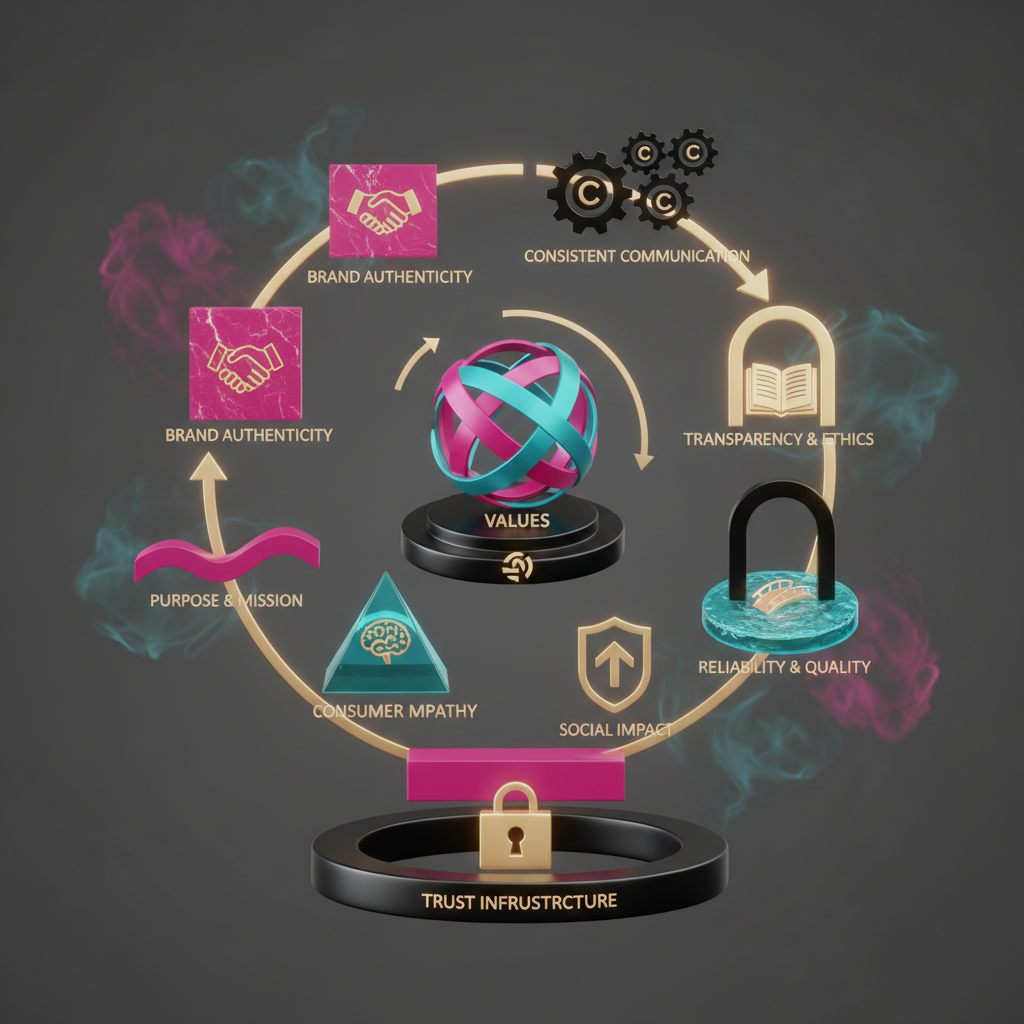
Where Values-Driven Branding Breaks Down
If the logic is this clear and the data this compelling, why do so many organizations fail to capture these benefits? The breakdown happens in three predictable places.
The Aspiration Gap
Many organizations define values based on who they want to be rather than who they actually are. The leadership team retreats to a conference room, brainstorms admirable qualities, and emerges with values that would make any company proud—and that have no connection to actual organizational behavior.
Employees immediately recognize the disconnect. Customers eventually do too. The result is worse than having no stated values at all, because now there's a visible gap between promise and reality. That gap is the opposite of trust.
If your brand messaging feels disconnected from daily operations, you're likely experiencing this pattern. Our analysis of why brands become disconnected from purpose explores recovery strategies.
The Operationalization Failure
Even organizations with authentic values often fail to embed them into systems. Values stay on the wall poster while hiring, training, performance evaluation, and customer interaction protocols remain unchanged.
This creates what I call values theater—a performance of alignment without the infrastructure to sustain it. Individual employees may embody values brilliantly, but the organization has no systematic way to ensure consistency when those individuals leave, scale, or face pressure.
The Measurement Void
What gets measured gets managed. Most organizations measure awareness, consideration, and conversion—but not trust itself. Without trust metrics, there's no feedback loop connecting values investment to business outcomes.
This leaves values-driven initiatives vulnerable to budget cuts during tight periods. Leaders can't defend what they can't quantify. The result is cyclical: invest in values, fail to measure impact, cut investment, wonder why customers seem less loyal.

Building Trust That Actually Converts
Converting trust from abstract aspiration to measurable business outcome requires systematic work across three dimensions.
Authentic Values Discovery
Start by examining what your organization actually does—not what it wishes it did. Interview long-tenured employees about moments of pride. Analyze decisions that felt obviously right. Study customer feedback for patterns in what they appreciate.
The values worth articulating are already present in your best behavior. Your job is to name them clearly enough that they can guide future behavior consistently.
Operational Integration
Once values are authentically identified, embed them into decision-making systems. This means:
- Hiring criteria that screen for values alignment
- Onboarding programs that teach values application
- Performance evaluation that rewards values-consistent behavior
- Customer service protocols built on values principles
- Marketing messaging that demonstrates rather than declares values
As McKinsey's research on brand values and business performance notes: "Brand values aren't fluff; they're strategic tools that shape perception, unify teams, and drive business outcomes." The key word is "tools"—values must function as operational instruments, not decorative statements.
Trust Measurement Infrastructure
Finally, build the metrics that connect values to outcomes. Track:
- Customer perception of values alignment (through surveys)
- Employee perception of values consistency (through internal measurement)
- Price sensitivity changes correlated with trust indicators
- Repeat purchase rates segmented by trust level
- Referral rates and advocacy metrics
This creates the feedback loop that sustains investment. When you can demonstrate that trust improvements correlate with revenue gains, values-driven branding moves from marketing initiative to strategic priority.

Frequently Asked Questions
What is values-driven branding?
Values-driven branding is the practice of making organizational values visible and operational across all brand touchpoints. Rather than treating values as internal HR statements, values-driven brands embed principles into messaging, service delivery, and customer experience. This creates recognizable consistency that 88-93% of executives link directly to bottom-line impact.
What is the difference between trust and loyalty in branding?
Trust is the belief that a brand will deliver on promises—it's earned through consistent alignment between values and actions. Loyalty is the behavioral outcome of sustained trust—continued purchasing despite alternatives. Trust precedes loyalty: 50-60% of consumers who trust a brand remain loyal, while distrust triggers the 35-45% who abandon brands entirely.
How does brand trust compare to brand awareness?
Brand awareness means people recognize you; brand trust means they believe you. Awareness gets attention; trust converts attention to action. You can have high awareness and low trust—a dangerous position where people know your name but won't buy. The 60-65% premium pricing advantage comes from trust, not mere recognition.
How do B2B and B2C brands differ in building trust through values?
B2C brands build trust through emotional resonance and visible values stances—Nike's Kaepernick campaign drove 25-35% sales growth in three days. B2B brands build trust through operational proof and consistent delivery. Both require values alignment, but B2B emphasizes reliability and expertise while B2C emphasizes shared identity and belonging.
Why do customers distrust brands that seem inconsistent?
Inconsistency signals unreliability—if messaging doesn't match experience, customers assume future promises won't be kept either. The brain treats brand interactions like relationship data: misalignment between values and actions triggers the same distrust response as discovering a person lied. This explains why 90-95% of consumers expect companies to actively build trust.
Sources
- PwC: Trust Survey - Building Business Trust in the Digital Age
- Edelman: 2024 Trust Barometer Global Report
- Harvard Business Review: The Business Case for Values-Based Leadership
- Forbes: How Nike Turned Values Into Revenue
- Pew Research Center: Americans and Trust in Brands
- McKinsey & Company: The Value of Getting Values Right
Continue with the strongest related paths.
These links stay inside the same published content group so the next step feels like a continuation of the answer, not a detour.
Brand Identity Is Not Your Logo: The Complete Picture 70-85% of Business Owners Miss
Brand identity isn't just your logo. Learn the three interconnected layers—visual, verbal, and experiential—that determine whether clients trust your business.
"Consistent vs. Cohesive Brand Identity: Why 60-80% of Brand Touchpoints Fail to Build Trust"
Learn why brand consistency without cohesion creates hollow repetition. Discover how to build strategic brand alignment that adapts to context and builds trust.
Why Your Brand Feels Disconnected from Your Purpose (And What to Do About It)
Most leaders sense when their brand doesn't match their organization's soul—they just can't name the gap. This piece names the specific disconnects between branding and mission/vision/values/UVP, helping readers diagnose what's actually broken before attempting fixes.
aspiration gap
The aspiration gap refers to the disconnect between stated values and actual behavior. This happens when organizations define values based on aspirational ideals rather than their true culture. Employees quickly recognize this disconnect, and customers eventually notice it too, creating a trust problem that is worse than having no stated values at all.
cognitive load reduction
Cognitive load reduction refers to the mental energy savings that customers experience when they trust a brand. Every purchase normally involves risk assessment questions about whether a product will work or whether the buyer will regret the decision. When customers trust a brand through values alignment and consistent behavior, their brain shortcuts this evaluation process, making purchasing decisions faster and easier.
decision-making infrastructure
Decision-making infrastructure refers to the systematic way organizations embed their values into everyday operations and protocols. When values are integrated into hiring, service delivery, and problem resolution processes, they create a framework that guides employee decisions and produces consistent customer experiences across all touchpoints.
Measurement Void
Measurement void refers to the absence of trust metrics in organizations. While companies measure standard marketing metrics like awareness and conversion rates, they fail to measure trust itself. Without trust metrics, there is no feedback loop to connect values investments to business outcomes, making it impossible to demonstrate the ROI of values-driven branding initiatives.
Stay Informed
Weekly insights, no spam