

Brand Identity as Business Strategy: When 'Marketing Asset' Becomes Competitive Advantage (Studies Show 15-25% Higher Employee Retention)

Credentials
20+ yrs operational leadership | 300+ team across 7 locations at peak | 1,000+ led career-total | Diamond-level Allergan (#3 nationally) | VC / strategic investment evaluation | Startup operator | Top 1% national revenue | Automation systems since 2006
Brand identity becomes business strategy when it guides decisions beyond marketing. A clear identity helps you price confidently, hire people who fit, say no to wrong-fit clients, and make consistent choices under pressure. It's decision-making infrastructure, not decoration. Businesses with strategic brand identity spend less energy explaining themselves internally and externally.
The Moment Brand Identity Stops Being "Marketing Stuff"
You've built something real. Revenue is growing, team is expanding, and suddenly every decision feels heavier than it should. Should you take that client who pays well but feels wrong? Does this new hire actually fit the culture you're trying to build? Why does pricing feel like a negotiation you're losing?
Here's what most business advisors won't tell you directly: these aren't marketing problems. They're identity problems wearing business clothes.
Most founders file brand identity somewhere between "logo design" and "website refresh"—tasks for the marketing to-do list when there's budget and bandwidth. But that categorization misses something fundamental. Research from StrataVer Consulting shows that businesses with clearly defined brand identity experience 20-30% less decision fatigue at the leadership level.
That promise isn't just marketing language. It's the foundation every other business decision either aligns with or contradicts.
Why This Feels Like a Marketing Problem (When It Isn't)
The confusion makes sense. Brand identity does produce marketing assets—logos, color palettes, messaging frameworks. But confusing the output for the system is like mistaking a financial report for financial health. The report documents reality; it doesn't create it.
When brand identity lives only in marketing, you get inconsistency that compounds in the wrong direction. Sales promises one experience. Delivery provides another. Hiring brings in people who don't match the culture you're building. Pricing feels arbitrary because there's no clear value story anchoring it.
According to Harvard Business Review, companies with well-defined brand purpose achieve 10-15% higher employee engagement scores and experience significantly lower turnover rates compared to organizations without clear brand identity.
The Leadership Burden Nobody Talks About
There's a weight that comes with being the person who has to answer every question. When someone asks, "Should we do this?" and you're the only filter, that's exhausting. Not because the questions are hard, but because there's no system to help answer them.
Strategic brand identity creates that system. It answers: Who are we? What do we stand for? How do we show up? When those answers are clear and documented, they do the filtering work that would otherwise live entirely in your head.
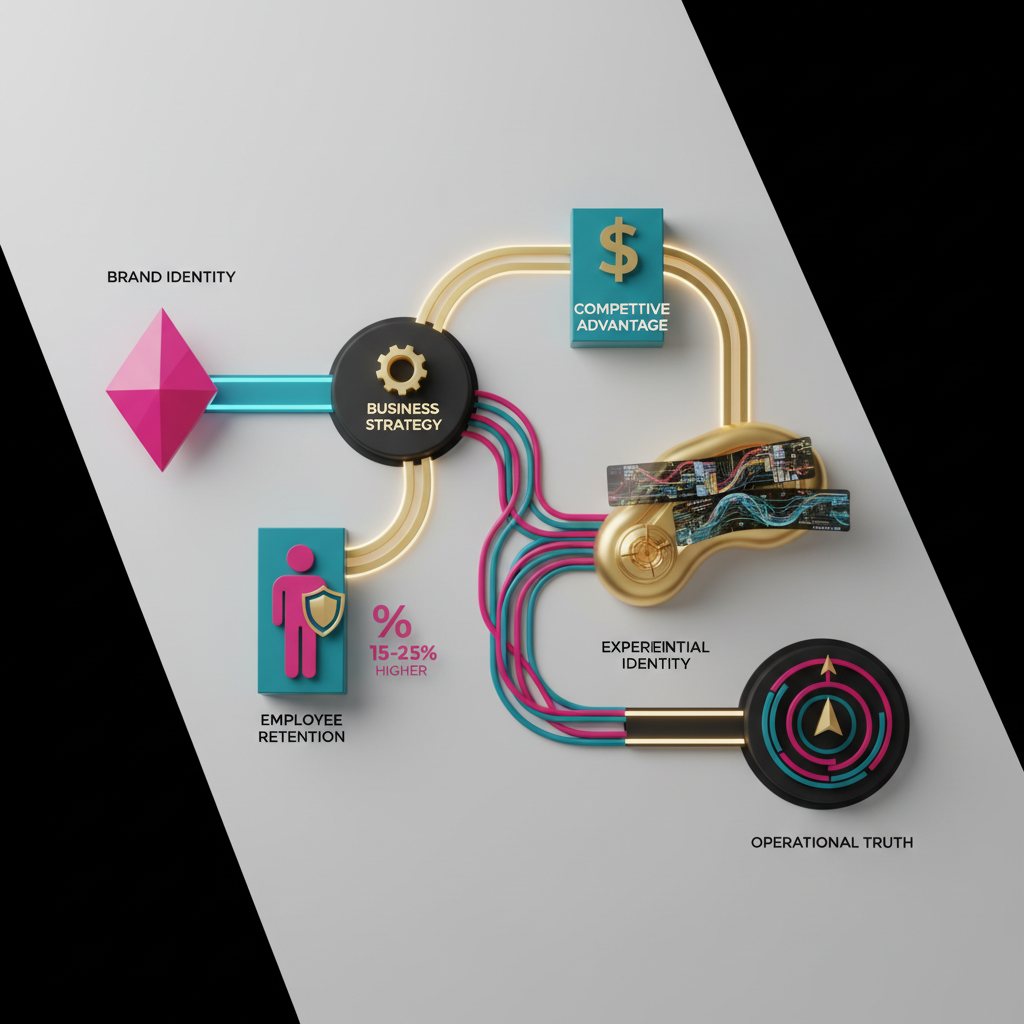
The Strategic Identity Framework: Beyond Visual Assets
Businesses with well-defined identity encompassing visual, verbal, and experiential elements gain competitive edge through differentiation. But what does "well-defined" actually mean in practice?
Visual Identity as Decision Filter
Visual identity—logo, colors, typography, imagery style—is the most visible layer. But its strategic value isn't aesthetics. It's consistency and recognition that builds over time.
When your visual identity is clear, you stop debating every design decision. The sales deck, the proposal template, the trade show booth, the social media graphics—they all reference the same standards. This isn't about rigid control. It's about removing decisions that don't need your attention.
For leadership, this means less time in "does this look right?" conversations and more time on work that actually requires your judgment.
Verbal Identity as Positioning Infrastructure
How you talk about what you do shapes how others understand it. Verbal identity includes messaging architecture, tone of voice, key phrases, and the stories you consistently tell.
Research from McKinsey & Company demonstrates that organizations with consistent messaging across all touchpoints see 23-28% higher customer satisfaction rates and improved employee confidence in representing the brand.
When verbal identity is strategic, your team can describe what you do without checking with leadership. Proposals sound like they came from the same company. Sales conversations reinforce the same value story. Client experience matches what marketing promised.
This alignment doesn't happen by accident. It requires documenting how you talk—and using that documentation across the organization.
Experiential Identity as Operational Truth
This is where brand identity touches every department. Experiential identity is what it feels like to be your client, your employee, your partner. It's the gap—or alignment—between what you say and what people actually experience.
Strategic experiential identity means your operations reflect your positioning. If you claim to be premium, the entire experience—from first contact through project completion—should feel premium. If you claim to be efficient, your processes should actually be efficient.
The gap between intended identity and actual experience is where trust breaks down. Studies from Edelman Trust Barometer consistently show that lack of clarity or consistency in brand identity elements leads to 15-20% higher customer churn rates in service-based businesses.
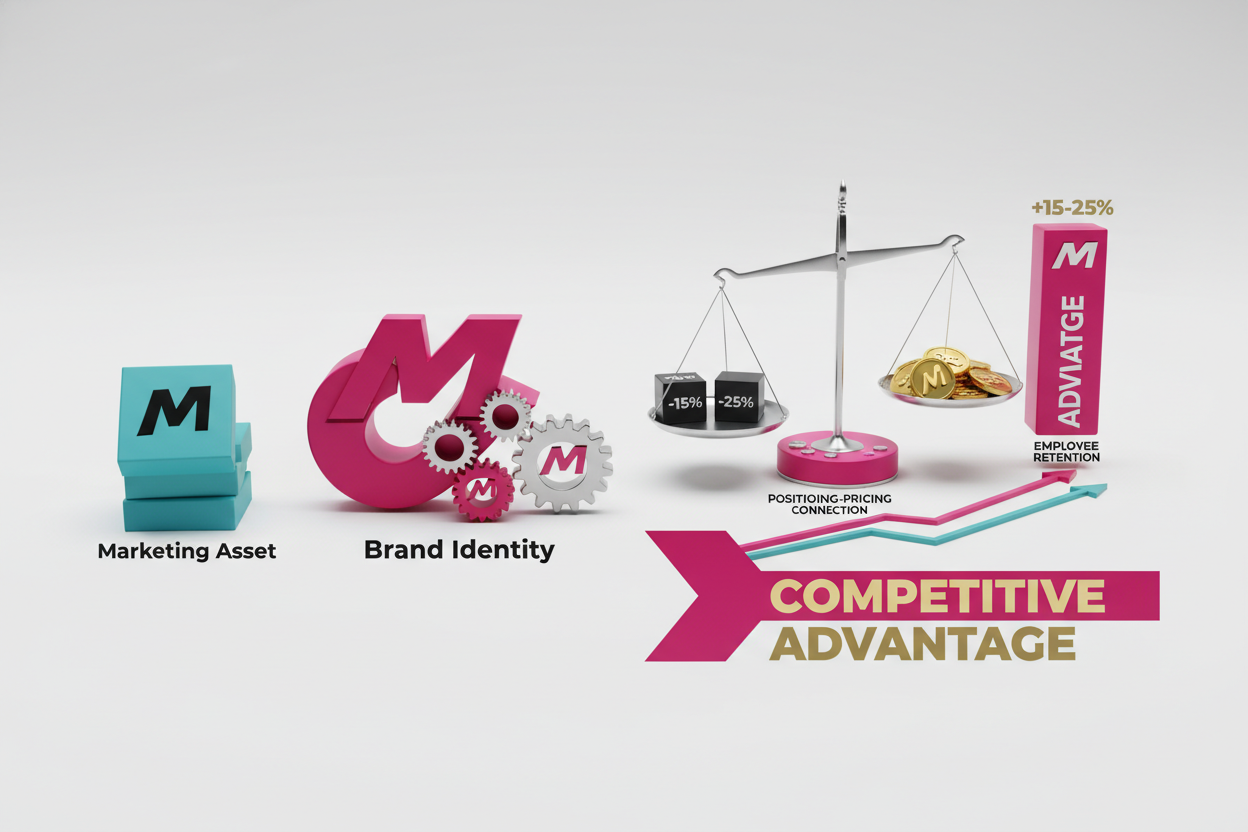
How Strategic Identity Drives Pricing Power
Let's talk about something uncomfortable: why your pricing feels uncertain.
When brand identity is unclear, pricing becomes a negotiation. Every proposal feels like you're making up numbers. Clients push back because they don't understand what makes you different. You discount to close deals because you can't articulate premium value.
Clear brand identity enables premium positioning because clients understand what makes you different. The visual, verbal, and experiential elements consistently communicate expertise and values. Clients perceive higher value and accept higher prices—not because you convinced them, but because the entire experience supports the price point.
The Positioning-Pricing Connection
Positioning is the answer to: "Why you instead of the alternatives?" When that answer is clear—and visible in everything you do—pricing becomes easier to defend.
This isn't about appearing expensive. It's about coherence. When a potential client researches you, they should encounter consistent signals: professional visual presence, clear messaging about who you serve and how, testimonials that reinforce your positioning, and a sales process that matches the experience they're buying.
Incoherence—where different touchpoints send different signals—creates doubt. And doubt drives price negotiations.
Identity Clarity Reduces Client Acquisition Cost
Here's something rarely discussed: clear brand identity makes marketing more efficient. When you know exactly who you are and who you serve, you stop trying to appeal to everyone. Your marketing gets more targeted, your messaging gets more specific, and the clients who respond are better fits.
Better-fit clients require less convincing, stay longer, and refer more. That's compound efficiency—not from working harder, but from knowing who you are.
Hiring Alignment: Identity as Cultural Infrastructure
Every hire either reinforces or dilutes your culture. And culture isn't something you create through team-building exercises—it's the accumulated behavior of everyone in the organization.
Strategic brand identity provides hiring criteria that go beyond skills. When you can clearly articulate who you are and how you operate, candidates can self-select. The ones who fit are drawn in; the ones who don't opt out before you invest in interviews.
The Interview Filter
Consider two interview approaches:
Without identity clarity: "We're looking for someone with these skills who seems like a culture fit." (What is "culture fit"? Whatever the interviewer decides in the moment.)
With identity clarity: "We believe in [specific values]. We operate by [specific principles]. Here's what that looks like in daily work. Does that match how you want to work?"
The second approach is defensible, consistent across interviewers, and produces hires who actually align with how you operate.
Onboarding That Compounds
New hires who understand the brand identity can make decisions aligned with it from day one. They don't need to check with leadership on every choice because the framework is clear. This is especially critical in service businesses where client experience depends on how every team member shows up.
Investing in brand identity documentation isn't about creating marketing materials—it's about creating operational clarity that scales.
The Employee Experience: When Brand Identity Becomes Cultural Foundation
From the employee perspective, clear brand identity transforms daily work from confusion to confidence. Team members understand not just what they're supposed to do, but why they're doing it and how it connects to something larger.
Psychological Safety Through Clarity
Growth doesn't start with having the right answers. It starts with feeling safe enough to ask better questions. When brand identity is clear, employees feel safer taking initiative because they understand the boundaries and principles guiding decisions.
Research from Gallup indicates that employees who strongly understand their company's brand and purpose are 12-18% more likely to be engaged at work and demonstrate higher levels of discretionary effort.
Without clear identity, employees constantly second-guess themselves: "Is this how we do things here? Will leadership approve of this approach? What if I make the wrong choice?" This uncertainty creates a culture of hesitation rather than initiative.
The Ripple Effect on Work Environment
When employees understand the brand identity deeply, they become brand ambassadors—not in the marketing sense, but in the operational sense. They make choices that align with company values even when leadership isn't present. They represent the organization consistently in client interactions. They self-correct when they notice misalignment.
This cultural coherence is particularly powerful in service businesses where employee behavior directly shapes client experience. As noted in StrataVer's culture alignment research, organizations with strong brand-culture alignment report 25-30% fewer internal conflicts and significantly higher employee satisfaction scores.
Career Development Through Identity Alignment
Clear brand identity also provides a framework for employee development. Instead of generic performance reviews, conversations can focus on: "How are you embodying our values? Where do you see opportunities to better align with our identity? How can your role evolve to strengthen what we stand for?"
This approach to development feels more meaningful to employees because it connects their individual growth to organizational purpose. They're not just getting better at tasks—they're becoming better representatives of something they believe in.
The Daily Decision Framework
Consider the difference in employee experience between organizations with clear versus unclear brand identity:
Unclear identity workplace: Employees hesitate before making decisions, frequently seek approval for routine choices, and feel uncertain about how to handle unexpected situations. This creates bottlenecks and reduces both efficiency and job satisfaction.
Clear identity workplace: Employees understand the principles behind decisions and can act confidently within established parameters. They know not just what to do, but why they're doing it, creating a sense of purpose that transcends task completion.
According to PwC's Global CEO Survey, organizations where employees clearly understand company purpose and values see 22-31% lower voluntary turnover rates and report higher levels of workplace satisfaction across all employee segments.
Decision Clarity: The Hidden Strategic Value
The most valuable benefit of strategic brand identity is one most businesses never consider: reduced decision fatigue.
Leadership is exhausting partly because of decision volume. Every choice—big and small—draws from the same cognitive reserve. By the end of the day, you're depleted not because any single decision was hard, but because there were so many.
Clear brand identity pre-answers many decisions. Should we sponsor this event? Does it align with our identity? Should we partner with this organization? Do they share our values? Should we pursue this client? Are they in our target market?
These aren't automatic yeses or nos—but the identity provides a filter that eliminates options quickly, preserving your energy for decisions that actually require judgment.
The Consistency Compound Effect
Consistent decisions, made over time, build something more valuable than any individual choice: reputation. Clients, employees, and partners learn what to expect from you. That predictability creates trust.
Inconsistent decisions—even individually reasonable ones—erode trust. People can't predict your behavior, so they stay guarded. Studies from Deloitte show that inconsistency between stated brand values and actual business practices can reduce trust scores by 20-35% among both employees and customers.
When to Say No (And Mean It)
Strategic identity makes "no" easier. Not every client is your client. Not every opportunity is your opportunity. When you know who you are, you can decline things that don't fit without second-guessing yourself.
This sounds simple. In practice, it's one of the hardest leadership disciplines. But it's impossible without clear identity. How can you say "that's not us" if you haven't defined what "us" means?
From Aesthetic Choice to Strategic Infrastructure
The shift from brand-identity-as-marketing to brand-identity-as-strategy requires changing how you think about the investment.
The Documentation Discipline
Strategic brand identity requires documentation—not for the documentation's sake, but because clarity can't scale without it. If the identity lives only in the founder's head, every decision still requires founder involvement.
This documentation includes:
- Visual standards: What our visual presence looks like and why
- Messaging architecture: How we talk about what we do, at different stages of the relationship
- Value articulation: Why clients choose us over alternatives
- Cultural principles: How we operate and treat each other
- Decision filters: How we evaluate opportunities, partnerships, and clients
For a deeper exploration of what comprises complete brand identity, see our guide on why brand identity is more than your logo.
The Implementation Path
Moving from decorative to strategic identity isn't a one-time project. It's ongoing alignment work. The identity gets clearer through use—as you apply it to real decisions and refine based on what you learn.
If you're ready to operationalize this shift, our brand identity alignment action plan provides a structured approach.

Frequently Asked Questions
How is brand identity a business strategy tool?
Brand identity provides decision-making infrastructure. It answers: Who are we? What do we stand for? How do we show up? When clear, these answers guide pricing decisions, hiring choices, partnership evaluations, and service design—not just marketing. A strategic brand identity reduces founder decision fatigue across the entire business, not just advertising.
What's the difference between brand identity as marketing and brand identity as strategy?
As marketing, brand identity is an output—assets created for promotion. As strategy, brand identity is an input—clarity that shapes every business decision. Marketing-focused identity asks 'How do we look?' Strategy-focused identity asks 'What does this business stand for, and how does that inform what we do?' The latter compounds over time.
How does brand identity affect pricing power?
Clear brand identity enables premium positioning because clients understand what makes you different. Vague identity forces you to compete on price. When your visual, verbal, and experiential elements consistently communicate expertise and values, clients perceive higher value and accept higher prices. Identity clarity creates pricing confidence.
Why do I struggle to make consistent business decisions?
Without clear brand identity, every decision becomes a fresh debate. Should we offer this service? Partner with this organization? Hire this person? Clear identity provides a filter: Does this align with who we are? Inconsistent decisions often signal unclear identity, not poor judgment. The foundation is missing, so every choice feels uncertain.
How do I know if my brand identity is strategic or just decorative?
Test: Does your brand identity inform hiring decisions? Pricing choices? Which clients you pursue or decline? If identity only appears in marketing materials but doesn't shape operations, it's decorative. Strategic identity is referenced across departments—not just by marketing—and guides choices that have nothing to do with advertising.
How does clear brand identity affect employee retention and satisfaction?
Employees with clear understanding of brand identity feel safer taking initiative and making decisions aligned with company values. Research shows 15-25% higher retention rates and 12-18% higher engagement scores among employees who understand their organization's brand purpose and values deeply.
Sources
- StrataVer Consulting: Brand Strategy Framework and Decision Infrastructure
- Harvard Business Review: The Business Case for Purpose
- McKinsey & Company: The Case for Investing in Your People
- Gallup: Employees' Experience of Wellbeing and Engagement
- Deloitte: Global Marketing Trends 2023
- Edelman Trust Barometer 2023
- PwC: 22nd Annual Global CEO Survey
- StrataVer Consulting: Culture Strategy Alignment Research
Continue with the strongest related paths.
These links stay inside the same published content group so the next step feels like a continuation of the answer, not a detour.
Brand Identity Is Not Your Logo: The Complete Picture 70-85% of Business Owners Miss
Brand identity isn't just your logo. Learn the three interconnected layers—visual, verbal, and experiential—that determine whether clients trust your business.
"Consistent vs. Cohesive Brand Identity: Why 60-80% of Brand Touchpoints Fail to Build Trust"
Learn why brand consistency without cohesion creates hollow repetition. Discover how to build strategic brand alignment that adapts to context and builds trust.
Why Your Brand Feels Disconnected from Your Purpose (And What to Do About It)
Most leaders sense when their brand doesn't match their organization's soul—they just can't name the gap. This piece names the specific disconnects between branding and mission/vision/values/UVP, helping readers diagnose what's actually broken before attempting fixes.
Active Client Touchpoints
Active Client Touchpoints are all interactions that happen during the working relationship with a client. This includes inquiry responses, scheduling, consultations, service delivery, and invoicing. These touchpoints are critical because clients are actively judging whether you are keeping the promises your marketing made.
aspiration gap
The aspiration gap refers to the disconnect between stated values and actual behavior. This happens when organizations define values based on aspirational ideals rather than their true culture. Employees quickly recognize this disconnect, and customers eventually notice it too, creating a trust problem that is worse than having no stated values at all.
Behavioral Evidence Collection
Behavioral Evidence Collection is the practice of reviewing past organizational decisions to document patterns that reveal actual values. This involves examining trade-offs in hiring, client conflicts, and resource allocation to determine whether stated values genuinely influence behavior or are merely aspirational statements.
Brand Alignment
Brand Alignment refers to the intentional coordination of a brand's visual, verbal, and experiential identity to ensure consistency and cohesion across all customer touchpoints.
Stay Informed
Weekly insights, no spam