

The Hidden Value in a Defined Cultural Ecosystem: Why Your Business Needs More Than Good Intentions

Credentials
20+ yrs operational leadership | 300+ team across 7 locations at peak | 1,000+ led career-total | Diamond-level Allergan (#3 nationally) | VC / strategic investment evaluation | Startup operator | Top 1% national revenue | Automation systems since 2006
A defined cultural ecosystem integrates values, SOPs, KPIs, policies, and behavioral standards into a reinforcing system where each element supports the others. Organizations with these ecosystems experience faster execution, better alignment, and reduced bottlenecks during scaling. The hidden value emerges when documentation becomes decision-making infrastructure rather than bureaucratic overhead.
The Expensive Illusion of Cultural Documentation
You have values on the wall. A handbook that lives in a drawer. Unwritten rules that everyone pretends to follow while quietly working around them. And somewhere in your inbox sits another request to "clarify expectations" for a situation your documented policies don't actually address.
How do I identify gaps between stated and actual behavioral expectations?
This is not a character flaw in your leadership. It's a systems failure masquerading as a culture problem.
How do SOPs compare to training in ensuring consistent performance?
According to Project Management Institute research on workplace project management, approximately 35-45% of projects fail due to misalignment and unclear accountability structures. The research reveals that fragmented decision-making doesn't just slow you down—it actively undermines execution at scale.
Standards of Behavior vs. Job Descriptions: Why Both Are Required for Team Alignment
The gap between having cultural documentation and having a cultural ecosystem costs more than most leaders realize. And that gap widens with every hire, every new initiative, every quarter where "culture work" gets pushed to next month.
Why Documents Don't Equal Direction
A values statement that doesn't connect to your hiring criteria is decoration. An SOP that nobody references because it contradicts your actual reward structures is waste. A policy handbook that requires a lawyer to interpret creates compliance without clarity.
The difference between documentation and ecosystem is the difference between ingredients and a recipe. Having flour, eggs, and sugar doesn't make a cake. Having values, SOPs, and policies doesn't make a culture.
What makes a culture is how these elements reference each other, reinforce each other, and resolve conflicts when priorities compete.
The Real Cost of Scattered Policies
Research from Harvard Business Review on executive attention management shows that fragmented systems consume leadership bandwidth exponentially, with executives spending 60-70% of their time on coordination rather than strategy.
When your cultural elements exist in isolation, every decision requires you. Every exception needs your judgment. Every conflict escalates to your desk because there's no architecture to handle it otherwise.
This is why leaders find themselves working in the business instead of on it. Not because they lack discipline, but because their systems don't produce decisions without them.
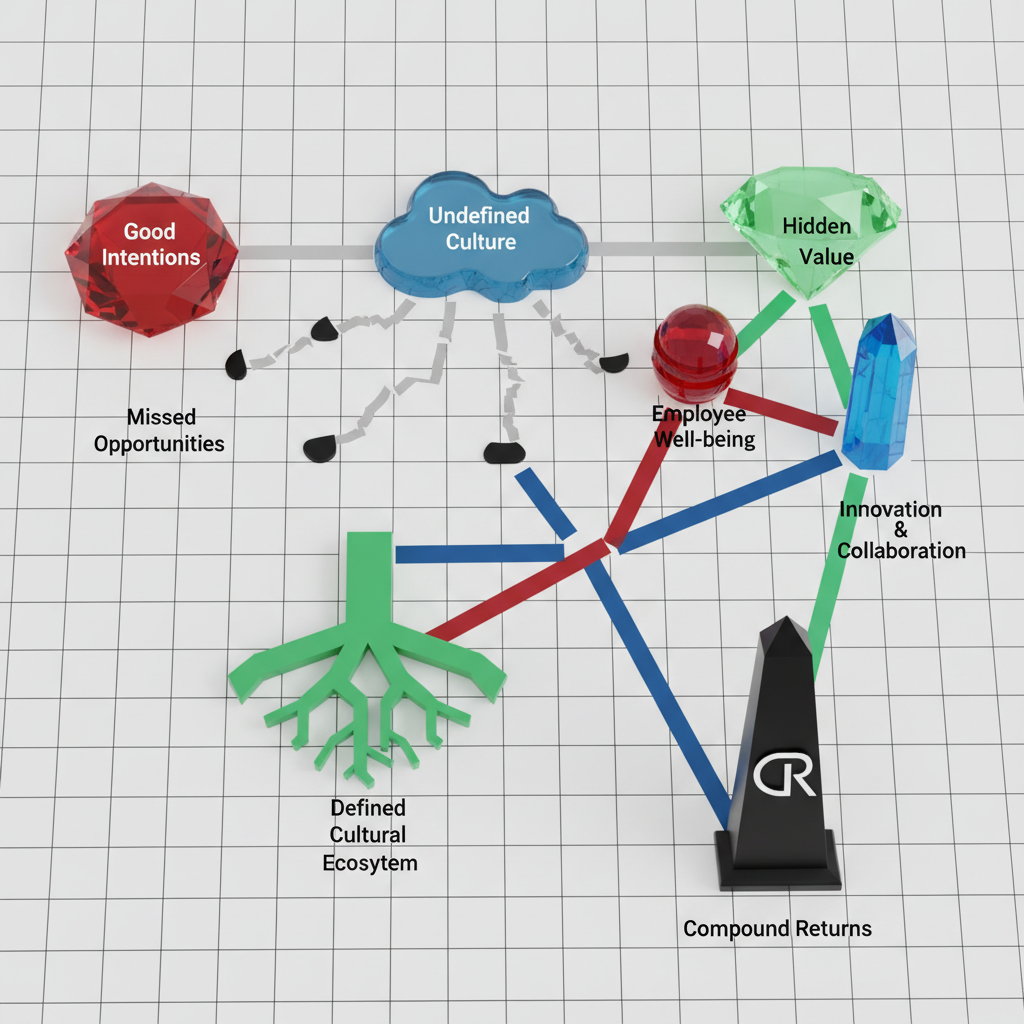
The Architecture of a Defined Cultural Ecosystem
A cultural ecosystem isn't a better handbook. It's a fundamentally different approach to how organizational clarity creates organizational capability.
What is a defined cultural ecosystem in business?
Think of it as infrastructure rather than documentation—the same way a city's water system is infrastructure, not just pipes. The pipes matter, but what matters more is how they connect, where they flow, and what happens when demand changes.
Five Elements That Must Reinforce Each Other
Your cultural ecosystem needs five interconnected components:
- Values that guide priorities when resources are limited
- SOPs that standardize execution without eliminating judgment
- KPIs that measure what actually matters, not just what's easy to count
- Policies that establish boundaries while enabling autonomy
- Standards of behavior that define how people interact when the handbook doesn't apply
Each element must reference the others. Your values should explain why certain SOPs exist. Your KPIs should measure adoption of those SOPs. Your policies should reflect your values in action. Your behavioral standards should be visible in who gets promoted and who doesn't.
When these connections break—when your values say "innovation" but your KPIs punish risk—you get cynicism instead of culture. Teams learn to ignore the wall decorations and watch what actually gets rewarded.
From Static Documents to Dynamic Decision-Making
The shift from documentation to ecosystem requires asking different questions:
Instead of "What should our values be?" ask "What decisions should our values help people make?"
Instead of "What policies do we need?" ask "What conflicts do our policies need to resolve without escalation?"
Instead of "How do we document our processes?" ask "How do our processes enable distributed authority?"
This is the difference between creating artifacts and creating infrastructure. Artifacts sit in folders. Infrastructure shapes daily behavior.
For a deeper exploration of how expectations drive team performance, see our analysis on why your team can't win without clear expectations.
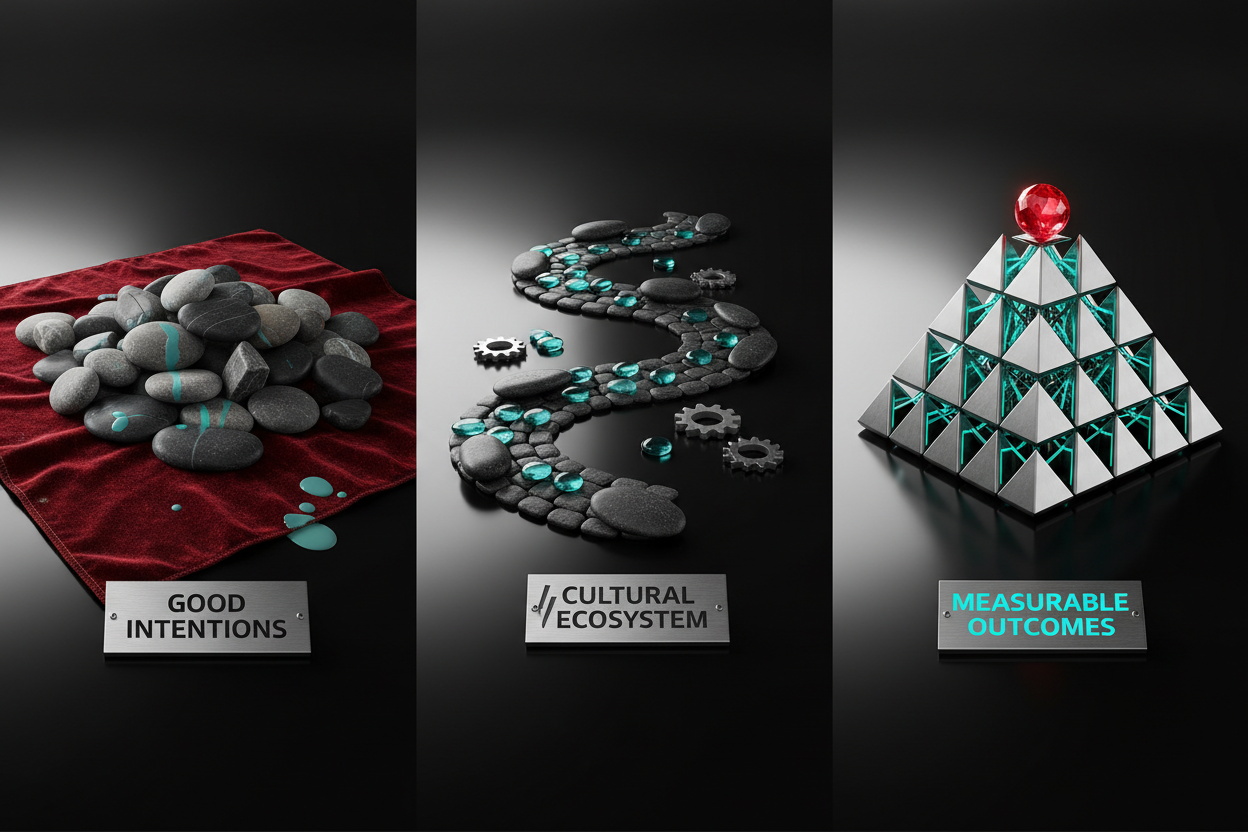
The Compound Returns of Integration
Scattered policies produce linear results at best. Integrated ecosystems create compound returns—where clarity in one area amplifies clarity in others.
According to McKinsey research on organizational alignment using the 7-S framework, organizations with integrated systems—where strategy, structure, systems, and shared values reinforce each other—experience significantly higher performance during scaling phases compared to those with fragmented approaches.
The reverse is also true: integrated decision-making, clear accountability, evolved processes, and consistent operating models reduce friction. As volume increases, these systems accelerate execution and amplify performance.
What Integration Actually Looks Like
Integration means your SOP for client onboarding explicitly references your value of "partnership over transaction." It means your hiring rubric includes questions that reveal alignment with behavioral standards. It means your performance reviews measure the KPIs that matter, not just activity metrics.
When a new hire asks "why do we do it this way?" the answer connects to something larger than "because that's the process." The process exists because of a value, which manifests through a standard, which gets measured by a KPI.
This isn't bureaucracy. It's architecture. And architecture enables freedom within structure—the opposite of chaos, which requires constant supervision.
The Leadership Time Dividend
Research from Deloitte's analysis of executive time allocation indicates that only 20-30% of senior leaders' time gets spent on strategic, value-creating work due to operational overload and fragmented systems requiring constant intervention.
A defined cultural ecosystem changes this ratio by distributing decision-making authority. When your team has clear values to reference, explicit standards to apply, and measurable KPIs to pursue, they don't need to escalate every judgment call.
This isn't about trusting people less—it's about trusting your systems more. Leaders who delegate via clear rules avoid becoming bottlenecks, enabling the distributed authority that scales.
The alternative is what most growth-stage companies experience: the founder becomes the cultural repository, the walking handbook, the living SOP. Every decision routes through one brain. And that brain is exhausted.

Why Good Intentions Aren't Enough
Most leaders have good intentions about culture. They want their people to thrive. They believe in their values. They hire for fit and care about retention.
But as U.S. Bureau of Labor Statistics data on job turnover consistently shows, organizational complexity increases exponentially with growth, creating structural challenges that good intentions alone cannot solve.
Good intentions without systems produce inconsistent outcomes. You hire someone aligned with your values, but their manager rewards different behavior. You create a policy that reflects your standards, but nobody enforces it because enforcement isn't tied to any KPI. You train on your SOPs, but people develop workarounds because the processes don't match reality.
The Gap Between Documented and Lived Values
Every organization has two cultures: the one described in documents and the one experienced in practice. The gap between them determines engagement, retention, and performance.
When documented values say "we value work-life balance" but managers send emails at midnight expecting responses, people learn the real rules. When policies say "we promote from within" but external hires keep appearing in leadership, people learn the actual priorities.
An ecosystem closes this gap by making values visible in daily operations. Not through enforcement, but through design—building systems where the documented culture is the lived culture because the infrastructure makes it so.
From Aspiration to Architecture
The shift from good intentions to ecosystem requires moving from aspiration to architecture:
- Aspiration: "We value transparency." Architecture: Weekly financial updates shared with all team leads, with specific metrics defined and responsibility assigned.
- Aspiration: "We're customer-focused." Architecture: Customer satisfaction scores visible in real-time, tied to team incentives, with escalation paths when scores drop.
- Aspiration: "We encourage innovation." Architecture: 10% time allocated to experimentation, with failure metrics distinguished from incompetence, and learning shared across teams.
Architecture makes aspiration tangible. And tangible systems produce consistent outcomes.
For a comprehensive framework on how SOPs, KPIs, and policies create this architecture, explore our guide on building cultural architecture through operational design.
Building Your Cultural Ecosystem
Starting this work doesn't require a retreat or a consultant or a six-month initiative. It requires a different lens on what you already have.
The Integration Audit
Begin by mapping the connections that should exist but don't:
- Values to SOPs: For each stated value, can you point to a specific process that embodies it? If "quality" is a value, which SOP includes quality checkpoints?
- SOPs to KPIs: For each critical SOP, do you measure adoption and outcomes? If you have an onboarding process, do you track how well it produces successful new hires?
- Policies to Values: For each policy, can you explain which value it supports? If not, the policy may be arbitrary—followed grudgingly rather than understood.
- KPIs to Behavior: Do your measurements drive the behavior you want? If you measure individual performance but want collaboration, your KPIs contradict your standards.
Gaps in these connections reveal where your ecosystem is fragmented. Each gap is a decision that escalates to you instead of resolving itself.
Starting Small, Building Systematically
You don't need to rebuild everything at once. Start with your highest-friction area—the decisions that keep landing on your desk, the conflicts that keep recurring, the expectations that keep confusing people.
For that area:
- Identify which cultural element is missing or disconnected
- Build the connection that would allow resolution without escalation
- Test whether the system produces consistent outcomes
- Expand once the pattern is proven
This is how architecture gets built: one load-bearing wall at a time, each one making the next possible.

Frequently Asked Questions
What are the components of a defined cultural ecosystem?
A defined cultural ecosystem includes five interconnected elements: values that guide priorities, SOPs that standardize execution, KPIs that measure success, policies that establish boundaries, and standards of behavior that define how people interact. The ecosystem works when these elements reference and reinforce each other rather than existing in isolation.
What is the difference between company culture and a cultural ecosystem?
Company culture is what actually happens—the behaviors, decisions, and norms people experience. A cultural ecosystem is the intentional architecture that shapes culture through documented values, processes, and accountability. Culture emerges whether you design it or not; an ecosystem ensures it emerges by design rather than default.
How does a cultural ecosystem compare to a policy handbook?
A policy handbook is a static document of rules; a cultural ecosystem is a dynamic system where policies connect to values, reinforce SOPs, and tie to measurable outcomes. Handbooks sit on shelves; ecosystems guide daily decisions. The difference shows in adoption—employees reference ecosystems because they solve problems, not just limit options.
What's the difference between documented values and lived values?
Documented values are statements of aspiration; lived values are reflected in how decisions actually get made, who gets promoted, and what behavior gets tolerated. The gap between documented and lived values creates cynicism. A cultural ecosystem closes this gap by making values visible in policies, measurable through KPIs, and enforceable through standards.
Why do cultural initiatives fail without ecosystem thinking?
Isolated initiatives lack reinforcement. A values rollout fails without policies that reflect those values. A new SOP fails without KPIs measuring adoption. Training fails without accountability for application. Each element needs the others—like exercise without nutrition or strategy without execution, partial approaches produce partial results.
Sources
Project Management Institute - Workplace Project Management Impact on Employee Engagement
These links stay inside the same published content group so the next step feels like a continuation of the answer, not a detour. Your SOPs tell people what to do. Your KPIs tell them if they did it well. Your policies tell them where the boundaries are. But most organizations create these in silos, wonder why they conflict, and blame employees for the confusion. This article shows how to architect these elements as an integrated system that compounds clarity instead of creating contradiction. Every time you let something slide, you've just created a new policy. Your team watches what you tolerate more closely than what you announce. This article unpacks why inconsistent enforcement destroys trust faster than having no rules at all—and how your silence is speaking volumes about what you actually value. Most leaders assume their team knows the rules because they've been mentioned once or twice. But undocumented expectations aren't rules—they're wishes. This article reveals the hidden cost of operating without explicit standards: 37% of projects fail due to misalignment, and your best people are making decisions in the dark. Compound Returns of Integration is the multiplying effect you get when your organizational systems work together instead of existing in isolation. When your values, processes, metrics, and policies all reference and reinforce each other, improvements in one area automatically strengthen the others. This creates exponential gains rather than linear progress, where increased business volume actually accelerates your execution instead of slowing you down with more friction and bottlenecks. Cultural Ecosystem Infrastructure is an integrated organizational system where all your cultural elements work together like infrastructure rather than existing as separate documents. Your values connect to your procedures, which link to your metrics, which align with your policies and behavioral standards. This creates a decision-making architecture that allows teams to act independently without constant leadership oversight, similar to how a city's water system functions as connected infrastru Distributed Authority refers to an organization's ability to let teams make decisions on their own without constantly asking leadership for approval. This happens when you have clear systems in place, like well-defined values, standards, and metrics, that give people the framework they need to make good judgment calls independently. Instead of every decision flowing through one person who becomes exhausted and overwhelmed, the decision-making power spreads throughout the organization in a contro Leadership Time Dividend refers to the strategic time that executives gain back when their organization has clear systems in place. When teams can make decisions using defined values, standards, and policies without constantly escalating to leadership, executives shift from spending most of their time on operational issues to focusing on high-value strategic work that actually grows the business. Weekly insights, no spamContinue with the strongest related paths.
SOPs, KPIs, and Policies: Building the Architecture of a Culture That Actually Works
Accepted Behavior Is Viewed as Endorsed: The Silent Message Your Inconsistency Sends
A Game Without Rules Isn't Worth Playing: Why Your Team Can't Win Without Clear Expectations
Compound Returns of Integration
Cultural Ecosystem Infrastructure
Distributed Authority
Leadership Time Dividend
Stay Informed