

Standards of Behavior vs. Job Descriptions: Why Both Are Required for Team Alignment

Credentials
20+ yrs operational leadership | 300+ team across 7 locations at peak | 1,000+ led career-total | Diamond-level Allergan (#3 nationally) | VC / strategic investment evaluation | Startup operator | Top 1% national revenue | Automation systems since 2006
Job descriptions define what employees must accomplish; standards of behavior define how they must conduct themselves while accomplishing it. Technical competence without behavioral alignment creates high performers who damage team culture. Documenting both creates complete expectations where employees understand that results matter, but so does how those results are achieved.
You hired someone brilliant. Their numbers are exceptional. Their technical execution is flawless. And your best employees are quietly updating their resumes because working alongside this person has become unbearable.
This is the gap between job descriptions and standards of behavior—and it costs organizations far more than most leaders calculate. According to Project Management Institute research, 30-40% of projects fail due to communication breakdown and unclear accountability. Much of that misalignment isn't about task confusion—it's about behavioral expectations that were never articulated in the first place.
The Fundamental Distinction: Outputs Versus Conduct
Job descriptions answer a straightforward question: What must this person accomplish? They outline responsibilities, reporting structures, required skills, and measurable deliverables. They're the contract between role and results.
Standards of behavior answer a different question entirely: How must this person show up while accomplishing those things? They address communication norms, conflict resolution expectations, collaboration requirements, and professional conduct—independent of any specific role.
Why Job Descriptions Alone Create Incomplete Expectations
A job description might specify that a project manager must "deliver projects on time and within budget." It says nothing about whether that manager can achieve those results through intimidation, public criticism of team members, or chronic unavailability for questions. Technically, the job is getting done. Practically, the organization is hemorrhaging talent and trust.
In my twenty-plus years of operational leadership across multiple industries, I've watched this scenario unfold repeatedly. The high performer who delivers exceptional results while creating interpersonal chaos. Leadership tolerates it because the numbers look good—until the hidden costs become impossible to ignore.
The Observable Difference Between Values and Standards
Company values state aspirational principles: integrity, innovation, respect, collaboration. Standards of behavior translate those abstractions into specific, observable actions. Values say "we believe in respect." Standards say "we respond to internal communications within four business hours, we don't interrupt colleagues during meetings, and we address concerns directly rather than through third parties."
This distinction matters because values alone are unenforceable. When an employee behaves disrespectfully, pointing to a value statement provides no clear benchmark for what should have happened instead. Standards create that benchmark. They make the invisible visible and the assumed explicit.
The Cost of Undocumented Behavioral Expectations
When standards exist only in leaders' minds—when they're "understood" rather than documented—enforcement becomes inconsistent and often personal. Different managers apply different thresholds. Similar behaviors receive different consequences depending on who commits them. Employees observe these inconsistencies and draw accurate conclusions about what actually matters.
Research from McKinsey on organizational performance shows that fragmented decision-making and unclear accountability create friction that slows execution and dilutes performance as volume increases.
The Multiplier Effect of Behavioral Ambiguity
Undocumented expectations create a cascading problem. New employees observe existing behavior to understand "how things really work here." When problematic behavior goes unaddressed, it becomes the de facto standard. When different people receive different consequences for similar actions, trust in leadership erodes.
This connects directly to why accepted behavior is viewed as endorsed behavior. Every time leadership ignores a behavioral violation, they're implicitly communicating that this behavior is acceptable—regardless of what any policy document states.
The Hidden Math of Tolerating Toxic Excellence
Leaders often calculate that a high performer's results outweigh their behavioral costs. This calculation typically ignores several significant factors:
- Disengagement costs: Other employees reduce effort when they observe double standards
- Talent avoidance: Strong performers refuse to work with or for toxic colleagues
- Cultural erosion: Tolerated behavior becomes "how things work here"
- Manager time drain: Leaders spend disproportionate time managing around difficult personalities
- Turnover cascade: One toxic star can drive multiple departures over time
The math only appears favorable because the hidden costs aren't quantified. When organizations track the full impact—including exit interviews, team productivity changes, and leadership time allocation—the equation shifts dramatically.

Building Both Systems: The Integration Requirement
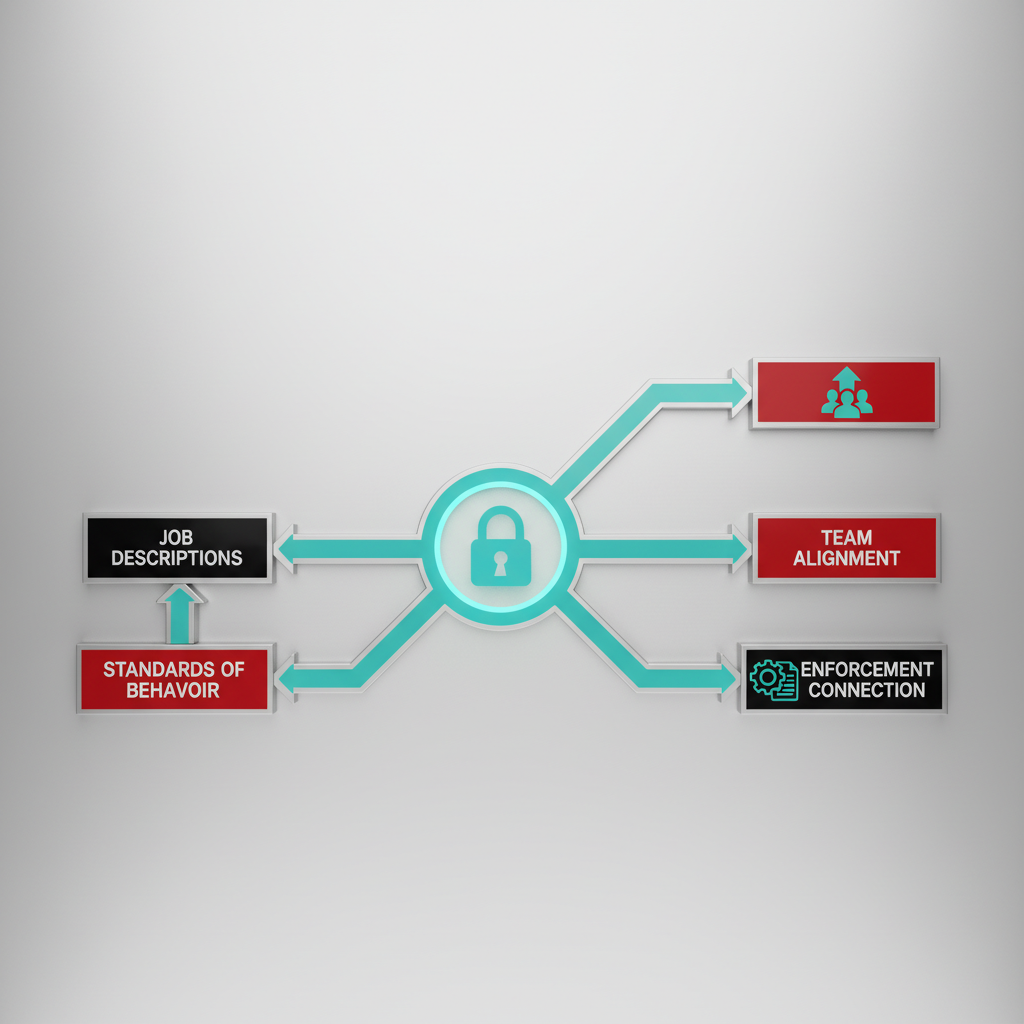
Effective team alignment requires both performance expectations (what to deliver) and behavioral expectations (how to operate while delivering). Neither alone creates complete clarity. Together, they form the foundation for consistent management and fair accountability.
What Belongs in Job Descriptions
Job descriptions should focus on role-specific deliverables and requirements:
- Primary responsibilities and key outcomes
- Technical skills and qualifications required
- Reporting relationships and team interactions
- Measurable performance indicators specific to the role
- Growth expectations and advancement criteria
These documents answer the question: "What does success look like in this specific position?" They're individual, role-specific, and focused on outputs.
What Belongs in Standards of Behavior
Standards of behavior should focus on universal expectations that apply regardless of role:
- Communication norms (response times, meeting conduct, feedback protocols)
- Collaboration requirements (how to engage across departments, escalation paths)
- Conflict resolution expectations (direct conversation first, no triangulation)
- Professional conduct standards (punctuality, preparation, follow-through)
- Treatment of colleagues, clients, and vendors
These expectations answer the question: "How do we operate here—regardless of your specific role?" They're universal, organization-wide, and focused on conduct.
The Documentation Imperative
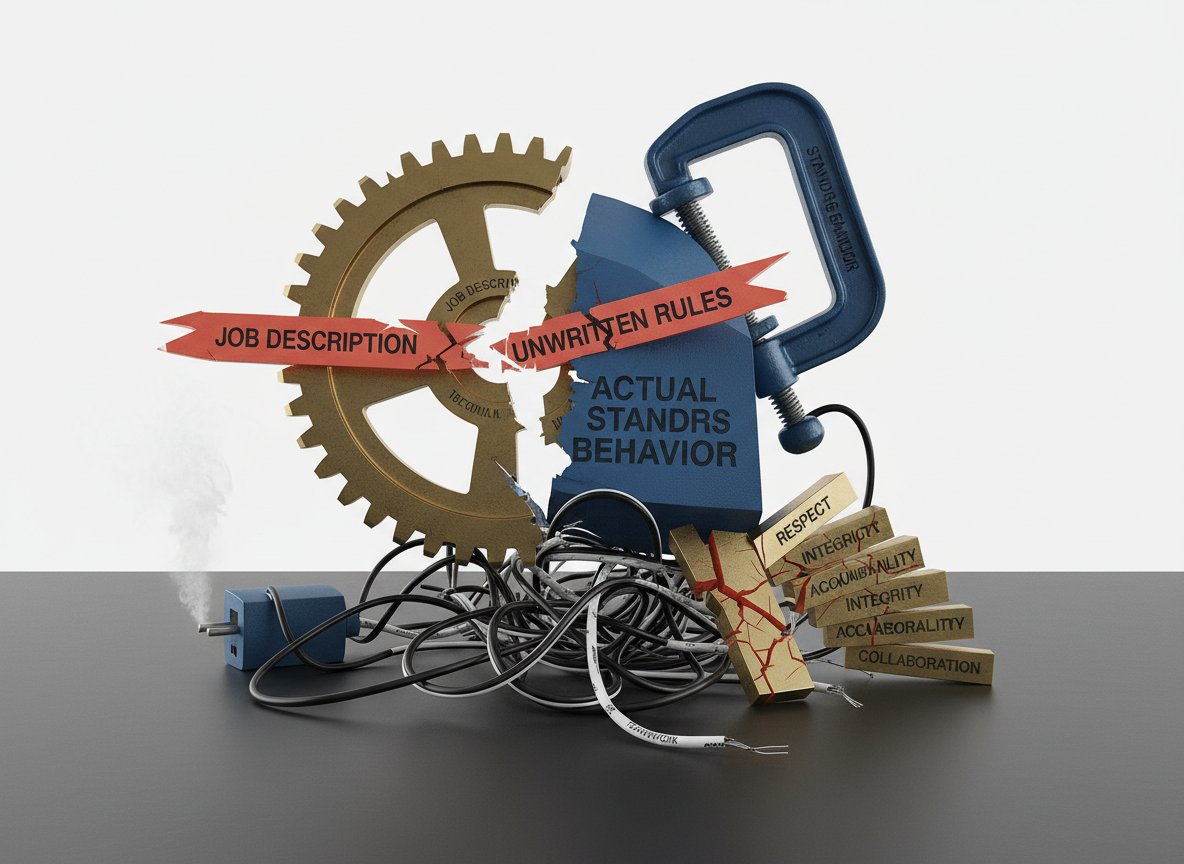
Unwritten standards create uneven enforcement. When behavioral expectations live only in leaders' assumptions, those assumptions vary between individuals and situations. Documentation creates the reference point that enables consistent accountability.
This connects to why SOPs, KPIs, and policies form cultural architecture—not bureaucratic overhead, but the infrastructure that enables fair, predictable management.
The Enforcement Connection
Documented standards without enforcement mechanisms are suggestions, not standards. The documentation must connect to clear consequences and documented disciplinary action processes. Employees need to understand not just what's expected, but what happens when expectations aren't met.
According to research from Harvard Business Review on executive decision-making, senior leaders make 35,000 decisions per day on average, leading to decision fatigue without clear processes. Documented behavioral standards reduce daily decision load by establishing clear frameworks. Leaders don't need to determine appropriate responses case-by-case; they reference established standards and apply consistent consequences.
Making Standards Observable and Measurable
Effective behavioral standards share several characteristics:
- Observable: You can see whether someone is following them
- Specific: They describe concrete behaviors, not vague qualities
- Consistent: They apply to everyone regardless of role or tenure
- Enforceable: They connect to clear consequences
- Reviewed: They're discussed during hiring, onboarding, and performance conversations
"Be professional" is not a standard—it's a hope. "Respond to internal communications within four business hours during work days" is a standard. One can be measured and enforced. The other invites endless interpretation.
Diagnosing Gaps in Your Current System
Most organizations have job descriptions. Fewer have documented standards of behavior. Even fewer have both integrated into their management and accountability systems. Identifying where gaps exist is the first step toward closing them.
Questions That Reveal Alignment Gaps
Ask yourself and your team:
- What behaviors get promoted or rewarded here—officially and unofficially?
- What behaviors get tolerated that probably shouldn't?
- Could two managers give different answers about whether a specific behavior is acceptable?
- Do employees know what happens if they violate behavioral expectations?
- Are consequences applied consistently regardless of performer level?
Gaps between stated expectations and actual consequences reveal where your documentation is incomplete or your enforcement is inconsistent. Both require attention.
The Employee Perspective Test
Survey employees on whether stated values match their daily experience. Ask specifically about behaviors they observe that seem inconsistent with company claims. The distance between official statements and lived reality shows where standards are aspirational rather than operational.
This isn't comfortable work. It requires acknowledging that what you've communicated and what you've permitted may not align. But that acknowledgment is prerequisite to building something better.
Implementation: Beyond Documentation
Creating documents is the easier part. Integrating those documents into how the organization actually operates requires more sustained effort.
Integration Points for Behavioral Standards
- Hiring: Discuss behavioral expectations during interviews and assess for alignment
- Onboarding: Review standards explicitly and have new hires acknowledge understanding
- Performance reviews: Include behavioral criteria alongside performance metrics
- Promotion decisions: Require behavioral alignment, not just performance achievement
- Coaching conversations: Reference documented standards when addressing concerns
- Disciplinary processes: Apply consistent consequences based on documented frameworks
Each touchpoint reinforces that behavioral standards matter as much as performance standards. Skipping any creates an implied message that behavior is secondary.
The Leadership Modeling Requirement
Standards that leadership violates are not standards—they're wishful thinking. If executives interrupt in meetings while expecting employees not to, if managers respond to messages inconsistently while expecting prompt responses, if senior leaders triangulate while forbidding it elsewhere—the real standard becomes "do as I say, not as I do."
This doesn't require perfection. It requires acknowledgment when leaders fall short and visible effort to improve. The standard isn't being flawless; it's being accountable.
Moving Forward: From Assumption to Architecture
The organizations that scale successfully don't just document what each role requires—they document how everyone should operate. Job descriptions without behavioral standards leave half the expectation unstated. Behavioral standards without job descriptions leave the other half unclear.
Clarity precedes growth. Most businesses scale chaos because they've invested in one system but assumed the other. They've documented roles thoroughly while leaving conduct to individual interpretation. Then they wonder why technically competent people create interpersonal problems that consume leadership bandwidth and drive turnover.
The solution isn't complicated, but it requires intentionality: document both. Enforce both. Review both during hiring, onboarding, and performance conversations. Hold everyone—including leadership—accountable to both.
Results matter. So does how those results are achieved. When organizations treat both as equally important and equally documented, team alignment becomes something designed rather than hoped for.

Frequently Asked Questions
What are standards of behavior in the workplace?
Standards of behavior are documented expectations for how employees interact with colleagues, customers, and work itself—independent of job-specific duties. They cover communication norms, conflict resolution expectations, collaboration requirements, and professional conduct. Unlike values which are aspirational, standards are observable and enforceable.
How do standards of behavior compare to company values?
Company values are broad principles (integrity, innovation, respect); standards of behavior are specific, observable actions that demonstrate those values in practice. Values say 'we value respect'; standards say 'we respond to internal messages within 4 hours, we don't interrupt in meetings, we give feedback directly rather than through third parties.'
What's the difference between performance issues and behavior issues?
Performance issues involve failing to achieve required outcomes (missing targets, producing low-quality work); behavior issues involve how someone operates (disrespecting colleagues, missing meetings, creating conflict). An employee can have excellent performance with poor behavior, or good behavior with poor performance. Each requires different coaching and documentation approaches.
Why do high performers get away with bad behavior?
Leaders often calculate that results outweigh behavior costs, fearing the performance gap if the person leaves. This calculation ignores hidden costs: other employees disengage watching double standards, talented people refuse to work with toxic colleagues, and culture erodes as behavior becomes 'the way things work here.' The math only works short-term.
How do I identify gaps between stated and actual behavioral expectations?
Observe what behaviors get promoted, what gets ignored versus addressed, and what stories people tell about 'how things really work.' Survey employees on whether stated values match their experience. Compare documented standards against actual consequences—gaps reveal where stated expectations are aspirational rather than operational.
Sources
Continue with the strongest related paths.
These links stay inside the same published content group so the next step feels like a continuation of the answer, not a detour.
SOPs, KPIs, and Policies: Building the Architecture of a Culture That Actually Works
Your SOPs tell people what to do. Your KPIs tell them if they did it well. Your policies tell them where the boundaries are. But most organizations create these in silos, wonder why they conflict, and blame employees for the confusion. This article shows how to architect these elements as an integrated system that compounds clarity instead of creating contradiction.
The Hidden Value in a Defined Cultural Ecosystem: Why Your Business Needs More Than Good Intentions
You have values on a wall, a handbook gathering dust, and unwritten rules everyone pretends to follow. But a cultural ecosystem isn't a collection of documents—it's a living architecture where each element reinforces the others. This article reveals how integrated systems create compound returns that scattered policies never will.
Accepted Behavior Is Viewed as Endorsed: The Silent Message Your Inconsistency Sends
Every time you let something slide, you've just created a new policy. Your team watches what you tolerate more closely than what you announce. This article unpacks why inconsistent enforcement destroys trust faster than having no rules at all—and how your silence is speaking volumes about what you actually value.
Compound Returns of Integration
Compound Returns of Integration is the multiplying effect you get when your organizational systems work together instead of existing in isolation. When your values, processes, metrics, and policies all reference and reinforce each other, improvements in one area automatically strengthen the others. This creates exponential gains rather than linear progress, where increased business volume actually accelerates your execution instead of slowing you down with more friction and bottlenecks.
Cultural Ecosystem Infrastructure
Cultural Ecosystem Infrastructure is an integrated organizational system where all your cultural elements work together like infrastructure rather than existing as separate documents. Your values connect to your procedures, which link to your metrics, which align with your policies and behavioral standards. This creates a decision-making architecture that allows teams to act independently without constant leadership oversight, similar to how a city's water system functions as connected infrastru
Defined Cultural Ecosystem
A Defined Cultural Ecosystem is an integrated organizational framework that deliberately connects values, standard operating procedures, performance indicators, policies, and behavioral standards. Each element reinforces the others, creating clear boundaries that enable employees to make autonomous decisions while maintaining alignment with organizational expectations.
Distributed Authority
Distributed Authority refers to an organization's ability to let teams make decisions on their own without constantly asking leadership for approval. This happens when you have clear systems in place, like well-defined values, standards, and metrics, that give people the framework they need to make good judgment calls independently. Instead of every decision flowing through one person who becomes exhausted and overwhelmed, the decision-making power spreads throughout the organization in a contro
Stay Informed
Weekly insights, no spam