

SOPs, KPIs, and Policies: Building the Architecture of a Culture That Actually Works

Credentials
20+ yrs operational leadership | 300+ team across 7 locations at peak | 1,000+ led career-total | Diamond-level Allergan (#3 nationally) | VC / strategic investment evaluation | Startup operator | Top 1% national revenue | Automation systems since 2006
SOPs, KPIs, and policies form a three-part system: SOPs standardize execution, KPIs measure outcomes, and policies establish decision boundaries. When designed together, they eliminate contradictions and enable autonomous decision-making. Organizations with integrated operational documentation experience reduced leadership bottlenecks and faster scaling because employees can act without constant permission-seeking.
The Hidden Cost of Disconnected Documentation
Your operations manual says one thing. Your performance review measures another. Your policy handbook contradicts both. And somewhere in the middle, an employee is frozen—unsure whether to follow the process, chase the metric, or respect the boundary.
Accepted Behavior Is Viewed as Endorsed: The Silent Message Your Inconsistency Sends
This isn't a people problem. It's an architecture problem.
According to the Project Management Institute's Pulse of the Profession research series, approximately 35-40% of organizational initiatives fail due to unclear accountability structures and misaligned execution frameworks. When SOPs, KPIs, and policies exist in silos, they create the very confusion that tanks execution.
In my 20+ years of operational leadership across medical aesthetics, wellness, and service industries, I've watched well-intentioned leaders build impressive documentation libraries that actively work against each other. They spend months creating SOPs, hire consultants to design KPI dashboards, and task HR with policy updates—never once considering how these three systems interact.
The Real Problem Isn't Missing Documentation
Most organizations don't lack documentation. They lack integration. The SOP says to prioritize customer satisfaction. The KPI dashboard measures transaction speed. The policy restricts refunds over $50 without manager approval. Now watch the frontline employee trying to satisfy an upset customer while the manager is in back-to-back meetings.
Research from Harvard Business Review's C-suite effectiveness studies shows that 70-75% of executive time is consumed by meetings, administrative work, and operational firefighting. Much of that firefighting comes from employees escalating decisions they should be empowered to make—but can't, because the documentation contradicts itself.
According to Forbes analysis on business documentation inefficiencies, companies with disconnected operational systems spend 15-25% more time on routine decision-making because employees must navigate conflicting guidelines rather than executing clear protocols.
Why Integration Beats Optimization
You can optimize each element perfectly and still fail. A perfectly written SOP that doesn't connect to measured outcomes produces compliant employees doing irrelevant work. A sophisticated KPI dashboard tracking metrics that policies make impossible to influence produces frustration and disengagement. Building the architecture of a culture that actually works requires designing these elements as a single system, not three separate projects.
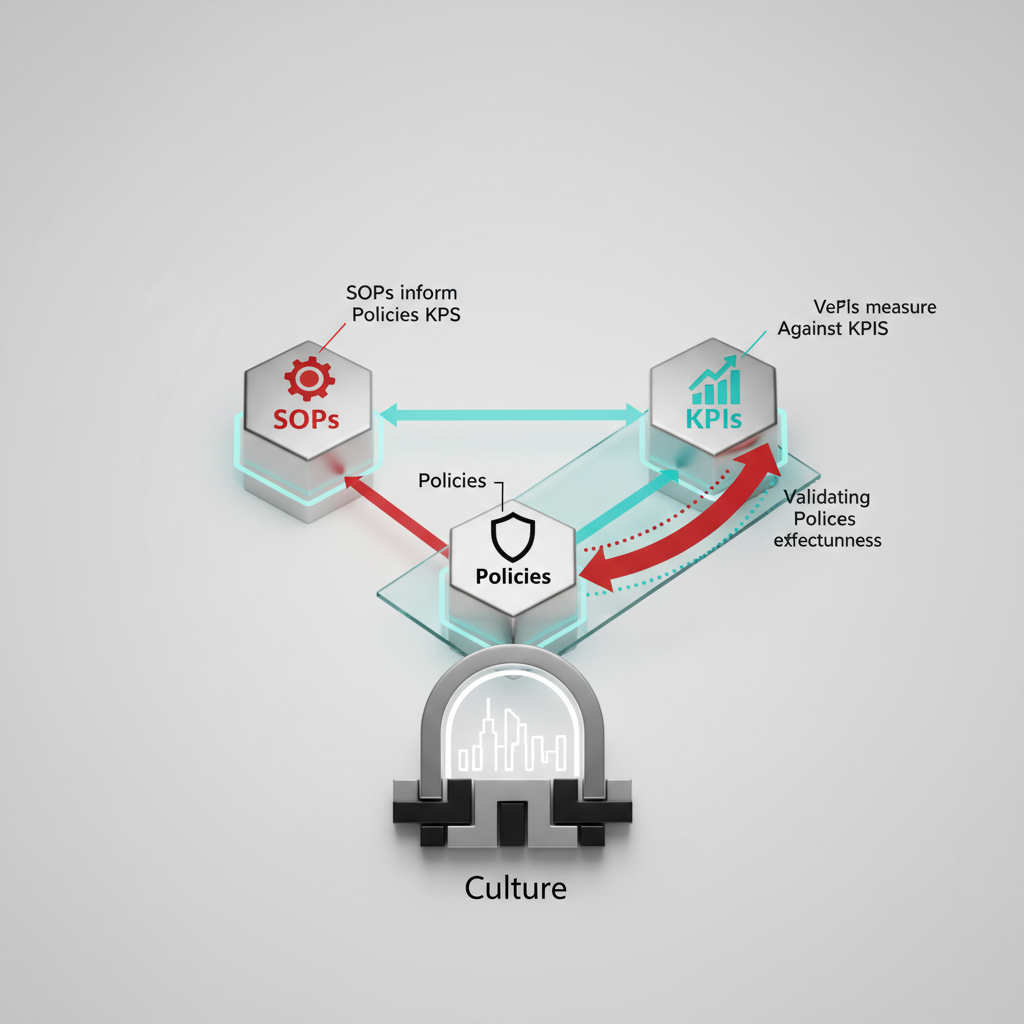
Understanding the Three Pillars
Before we can integrate these elements, we need clarity on what each one actually does—and doesn't do.
SOPs: The How of Execution
Standard Operating Procedures codify your best practices. They answer the question: "What does good look like, step by step?" SOPs exist to create consistency—so that Tuesday's results don't depend on whether Sarah or Marcus is working.
But here's what SOPs cannot do: they can't motivate. They can't measure. They can't handle exceptions. An SOP that tries to cover every possible scenario becomes a novel nobody reads. The most effective SOPs are narrow, specific, and connected to outcomes employees actually care about.
As documented by StrataVera Consulting in our operational intelligence framework, SOPs without clear consequences for deviation become suggestions rather than standards.
KPIs: The Whether of Success
Key Performance Indicators measure outcomes. They answer the question: "Did we accomplish what matters?" KPIs exist to create visibility—so leadership knows where attention is needed without micromanaging every task.
According to Harvard Business Review's analysis of executive time allocation research, only 25-30% of a CEO's time is spent on high-value strategic work. The rest disappears into operational noise. Properly designed KPIs should reduce that noise by surfacing what matters and filtering what doesn't.
But KPIs fail when they measure activity instead of outcomes, when they conflict with stated values, or when employees have no visibility into how their work affects the numbers.
Policies: The Where of Boundaries
Policies define decision-making boundaries. They answer the question: "What are we willing and unwilling to do?" Policies exist to create autonomy—yes, autonomy. A clear boundary lets employees make decisions without escalating every exception.
The counterintuitive truth: more policies can mean more freedom. When employees know the boundaries explicitly, they can move confidently within them. It's the ambiguous policies—or the absent ones—that create paralysis.

The Architecture of Integration
Integration isn't about creating one massive document. It's about ensuring each element reinforces the others.
Mapping SOPs to KPIs
Every SOP should connect to at least one KPI. If you can't identify which metric the procedure affects, ask why the procedure exists. This doesn't mean every step has a dashboard widget. It means the procedure's purpose is measurable.
The mapping exercise often reveals ghost procedures—SOPs that exist because "we've always done it" but don't connect to any outcome anyone measures or values. These are candidates for elimination, not optimization.
This principle extends to your broader cultural infrastructure. As documented by StrataVera Consulting in our cultural ecosystem framework, documentation that doesn't connect to measured outcomes eventually gets ignored.
Validating Policies Against KPIs
For every KPI, identify the behaviors required to achieve it. Then check your policies: do any of them prohibit, complicate, or slow those behaviors?
Common contradictions I've seen in my consulting work:
- Customer satisfaction KPI + rigid return policy = frontline employees can't resolve complaints without escalation
- Innovation metrics + extensive approval processes = ideas die in committee before testing
- Speed-to-completion KPI + mandatory documentation at every stage = people skip documentation to hit targets
- Collaboration metrics + individual bonus structures = hoarding information becomes rational
Contradiction creates impossible choices. Employees either fail the metric or violate the policy—and both outcomes erode trust.
Designing Policies That Enable SOPs
Policies should create the conditions under which SOPs can succeed. If your sales SOP requires quick proposal turnaround, your approval policy needs to accommodate that timeline. If your customer service SOP empowers resolution, your financial policy needs to define the resolution budget.
The question isn't "What rules do we need?" but "What rules will make our processes work?"

Building the System: A Practical Framework
Integration requires a deliberate process. Here's the framework I use with clients navigating this complexity:
Step 1: Audit for Contradiction
Gather your existing SOPs, KPIs, and policies. For each KPI, trace backward:
- What behaviors drive this metric?
- Do our SOPs codify those behaviors?
- Do any policies prevent or complicate those behaviors?
Document every gap and contradiction. This audit typically reveals that 30-50% of documentation either conflicts with other documentation or connects to nothing measurable.
Step 2: Establish Ownership and Review Cycles
Documentation without ownership decays. Assign each SOP, KPI, and policy to a specific person—not a department, a person. That person is responsible for:
- Quarterly relevance reviews
- Collecting feedback from users
- Proposing updates when circumstances change
- Ensuring alignment with connected elements
As documented in McKinsey's operational excellence research, fragmented decision-making and unclear accountability create friction that compounds as organizations grow, slowing execution and diluting performance.
Research from The New York Times workplace productivity analysis indicates that organizations with clear ownership structures for operational documentation see 20-35% fewer operational bottlenecks compared to those with distributed or unclear accountability.
Step 3: Create Cross-Reference Maps
Build a simple reference showing how elements connect:
- SOP X → Supports KPI Y → Enabled by Policy Z
- Policy A → Enables SOPs B, C, D → Which drive KPIs E, F
When someone proposes changing any element, this map reveals the downstream effects. Changes to Policy Z require reviewing whether SOP X still works and whether KPI Y is still achievable.
Step 4: Test with Frontline Reality
Documentation created in conference rooms often fails in the field. Before finalizing any integrated system, test it with the people who actually do the work:
- Can they follow the SOP as written?
- Do they understand how their work affects the KPI?
- Do the policies give them enough room to succeed?
Their feedback isn't optional input—it's essential validation. The architecture only works if the people inside it can navigate it.
The Cultural Payoff
Integrated operational architecture doesn't just improve efficiency. It transforms culture.
From Confusion to Clarity
When SOPs, KPIs, and policies align, employees stop asking "What should I do?" They know. They stop escalating every edge case. They handle it. They stop choosing between conflicting demands. There's no conflict.
This is what we describe at StrataVera Consulting as the hidden value of a defined cultural ecosystem—clarity that compounds over time as people internalize the system.
From Bottleneck to Distributed Authority
Leadership bottlenecks exist because employees don't have the information or permission to decide independently. Integrated documentation provides both. The SOP shows how. The KPI shows whether it worked. The policy shows where the boundaries are.
Suddenly, decisions that required a manager's approval happen automatically—correctly—without the delay.
From Firefighting to Strategy
Remember that 25-30% figure—the portion of executive time actually spent on strategy? Integrated documentation increases that percentage by eliminating the questions, conflicts, and escalations that consume the other 70-75%.
This isn't about working harder. It's about building systems that don't require constant intervention.
The Path Forward
Most organizations create SOPs, KPIs, and policies in silos, wonder why they conflict, and blame employees for the confusion. The blame is misplaced. The architecture was flawed from the start.
Building operational documentation that actually works requires treating these three elements as a single integrated system. SOPs without KPIs are activity without purpose. KPIs without enabling policies are targets without tools. Policies without connected SOPs are boundaries without paths.
The architecture is universal. The application is industry

Frequently Asked Questions
What is the relationship between SOPs, KPIs, and policies?
SOPs define how work gets done, KPIs measure whether it's done effectively, and policies establish the boundaries within which decisions are made. When aligned, SOPs enable the behaviors that drive KPIs, and policies prevent decisions that would undermine either. Misalignment creates employees following processes that don't produce measured results.
How do SOPs compare to training in ensuring consistent performance?
Training transfers knowledge once; SOPs provide ongoing reference. Studies show employees retain only 10-20% of training after one month without reinforcement. SOPs serve as that reinforcement—accessible documentation employees can consult when memory fails. Best practice combines initial training with SOPs that make trained behaviors repeatable without retraining.
What's the difference between outcome KPIs and activity KPIs?
Outcome KPIs measure results (revenue generated, customer satisfaction, retention rates); activity KPIs measure actions (calls made, meetings held, reports filed). Organizations over-indexed on activity KPIs create busy teams that aren't productive. Balanced measurement connects activities to outcomes—ensuring effort translates to impact rather than just motion.
Why do SOPs become outdated and ignored?
SOPs become outdated when ownership isn't assigned, review cycles aren't scheduled, and feedback loops don't exist. They're ignored when they don't reflect actual best practices, when following them creates friction without clear benefit, or when leadership doesn't model their use. Living SOPs require maintenance infrastructure—not just creation effort.
How do I audit whether my policies contradict my KPIs?
Map each KPI to the behaviors required to achieve it, then check if any policy prohibits or complicates those behaviors. Common contradictions: customer satisfaction KPIs with rigid return policies, innovation metrics with risk-averse approval processes, speed metrics with extensive documentation requirements. Contradiction creates impossible choices for employees.
Continue with the strongest related paths.
These links stay inside the same published content group so the next step feels like a continuation of the answer, not a detour.
The Hidden Value in a Defined Cultural Ecosystem: Why Your Business Needs More Than Good Intentions
You have values on a wall, a handbook gathering dust, and unwritten rules everyone pretends to follow. But a cultural ecosystem isn't a collection of documents—it's a living architecture where each element reinforces the others. This article reveals how integrated systems create compound returns that scattered policies never will.
Accepted Behavior Is Viewed as Endorsed: The Silent Message Your Inconsistency Sends
Every time you let something slide, you've just created a new policy. Your team watches what you tolerate more closely than what you announce. This article unpacks why inconsistent enforcement destroys trust faster than having no rules at all—and how your silence is speaking volumes about what you actually value.
A Game Without Rules Isn't Worth Playing: Why Your Team Can't Win Without Clear Expectations
Most leaders assume their team knows the rules because they've been mentioned once or twice. But undocumented expectations aren't rules—they're wishes. This article reveals the hidden cost of operating without explicit standards: 37% of projects fail due to misalignment, and your best people are making decisions in the dark.
Operational Architecture
Operational architecture is the integrated system formed by standard operating procedures, key performance indicators, and policies when they're designed to work together rather than existing as separate documents. This architecture eliminates contradictions by ensuring procedures connect to measured outcomes and policies enable rather than obstruct execution, allowing employees to make decisions autonomously.
Compound Returns of Integration
Compound Returns of Integration is the multiplying effect you get when your organizational systems work together instead of existing in isolation. When your values, processes, metrics, and policies all reference and reinforce each other, improvements in one area automatically strengthen the others. This creates exponential gains rather than linear progress, where increased business volume actually accelerates your execution instead of slowing you down with more friction and bottlenecks.
Cultural Ecosystem Infrastructure
Cultural Ecosystem Infrastructure is an integrated organizational system where all your cultural elements work together like infrastructure rather than existing as separate documents. Your values connect to your procedures, which link to your metrics, which align with your policies and behavioral standards. This creates a decision-making architecture that allows teams to act independently without constant leadership oversight, similar to how a city's water system functions as connected infrastru
Defined Cultural Ecosystem
A Defined Cultural Ecosystem is an integrated organizational framework that deliberately connects values, standard operating procedures, performance indicators, policies, and behavioral standards. Each element reinforces the others, creating clear boundaries that enable employees to make autonomous decisions while maintaining alignment with organizational expectations.
Stay Informed
Weekly insights, no spam