

How to Audit Your Brand for Mission Alignment (With a Practical Framework)

Credentials
20+ yrs operational leadership | 300+ team across 7 locations at peak | 1,000+ led career-total | Diamond-level Allergan (#3 nationally) | VC / strategic investment evaluation | Startup operator | Top 1% national revenue | Automation systems since 2006
A brand mission alignment audit evaluates consistency across three layers: visual identity, verbal identity, and experiential identity. Use the Side-by-Side Test—display all touchpoints together and check if each clearly connects to your mission, vision, values, and UVP. Common gaps include messaging that promises values the experience doesn't deliver, creating the trust erosion that causes 40% of consumers to abandon brands.
You know something is off. The brand looks polished, the messaging reads well, but there's a persistent disconnect between what you say you are and how people experience you. This isn't a creative problem—it's an alignment problem. And it's costing you more than you realize.
According to PwC's 2024 Trust Survey, 40% of consumers have stopped purchasing from a company due to a lack of trust. That trust erosion rarely happens because of a bad logo or outdated website. It happens when the brand promise doesn't match the brand experience—when what you claim conflicts with what you deliver.
The audit framework that follows isn't about surface-level fixes. It's about diagnosing where your brand identity has drifted from your organizational purpose, then creating a systematic path back to alignment. In my 20+ years of building decision-making infrastructure for growth-stage businesses, I've found that most brand misalignment isn't visible until you examine all three layers simultaneously.
Understanding the Three Layers of Brand Identity
Brand identity operates across three distinct but interconnected layers. Most audits focus exclusively on visual identity—what I call the Logo Illusion—while ignoring the verbal and experiential layers where trust actually forms or fractures.
Visual Identity: What People See
Visual identity encompasses every element that creates visual recognition: logo, color palette, typography, photography style, physical environment, and digital design patterns. These elements should work together to communicate something meaningful about who you are.
But here's what most leaders miss: visual consistency isn't the same as visual alignment. You can have perfectly consistent visual assets that communicate nothing about your actual mission. A law firm that values accessibility might have elegant, intimidating visual branding that creates psychological distance. The visuals are consistent; they're just consistently misaligned.
Verbal Identity: How You Sound
Verbal identity includes tone of voice, messaging frameworks, language patterns, and the specific words you choose across every communication touchpoint. This is where Identity Fragmentation typically surfaces first—when team members describe the business differently, when email communication doesn't match website copy, when sales conversations contradict marketing promises.
According to Edelman's 2024 survey, 84% of consumers across all age groups need to share values with a brand in order to buy it. But values can't be shared if they're communicated inconsistently—or not communicated at all.
Experiential Identity: What People Feel
Experiential identity is how clients feel at every touchpoint, from first discovery through post-engagement. This layer is the hardest to audit and the most consequential to get wrong. It's where the Promise-Experience Gap lives—that disconnect between what your marketing promises and what your delivery provides.
A brand can have beautiful visuals and compelling messaging while delivering an experience that contradicts both. The website promises personalized service; the intake process feels automated and impersonal. The values claim innovation; the client experience follows a rigid, outdated template. These gaps create cognitive dissonance, and cognitive dissonance destroys trust.
The Four Alignment Anchors: Mission, Vision, Values, and UVP
Before auditing the three brand layers, you need clarity on what you're aligning to. Every touchpoint should connect to at least one of these four anchors—and ideally reinforce multiple anchors simultaneously.
Mission: Your Operating Purpose
Your mission defines why you exist right now—the specific problem you solve and for whom. During the audit, you'll evaluate whether each brand touchpoint clearly supports this operating purpose or creates confusion about what you actually do.
Vision: Your Future State
Your vision describes where you're headed—the future you're building toward. Brand alignment means your current expression should feel like a credible step toward that vision, not a contradiction of it.
Values: Your Decision-Making Framework
Values aren't aspirational statements—they're observable decision-making patterns. PDC Graphics notes, "When your branding reflects the values at the heart of your mission, it builds trust and fosters meaningful relationships that drive positive social impact." The audit evaluates whether your stated values are actually evident in how your brand behaves.
UVP: Your Differentiated Position
Your Unique Value Proposition articulates why clients should choose you over alternatives. Every brand touchpoint should reinforce this differentiation—not dilute it with generic messaging that could describe any competitor.
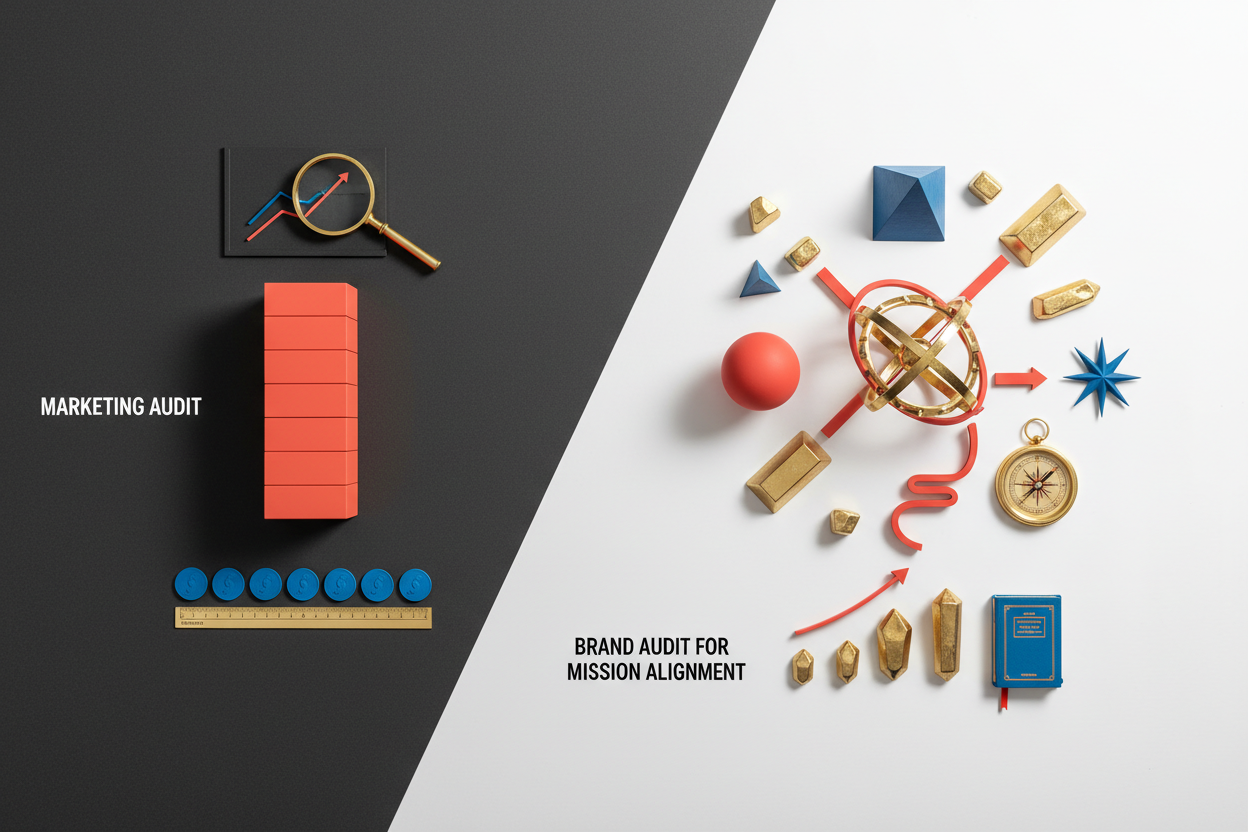
The Brand Mission Alignment Audit Framework
This framework provides a structured diagnostic approach. You'll move through each brand layer, evaluating alignment against all four anchors. Document everything—the gaps you find become your remediation roadmap.
What is the ROI of aligning brand with mission and values?
Step 1: Gather Your Touchpoint Inventory
Before you can audit, you need a complete inventory. Map every touchpoint across three phases:
- Pre-Client Touchpoints: Website, social profiles, advertising, content, proposals, initial communications, referral conversations
- Active Client Touchpoints: Onboarding, service delivery, invoicing, progress communications, support interactions, meetings
- Post-Client Touchpoints: Follow-up sequences, review requests, referral programs, alumni communications, re-engagement campaigns
Most organizations discover touchpoints they'd forgotten existed—automated emails from five years ago, outdated capability decks, inconsistent proposal templates. This inventory alone often reveals obvious gaps.
Step 2: Execute the Side-by-Side Test
The Side-by-Side Test is a visual audit technique where all brand touchpoints are displayed together. Print screenshots, pull documents, display everything simultaneously—website next to business cards next to proposals next to email signatures next to physical environment photos.
Ask three questions of this assembled view:
- Do these all look like they come from the same organization?
- Do they communicate a consistent message about what this organization believes?
- Could a stranger identify our mission, vision, or values from this collection?
If something feels "off" about your brand but you can't articulate why, this test typically reveals the source. You'll see the Digital-Physical Disconnect, the inconsistent visual applications, the messaging contradictions.
Step 3: Conduct the Team Consistency Check
The Team Consistency Check is an audit technique where multiple team members independently describe the business. Give five team members the same prompt: "Describe what we do, who we serve, and what makes us different—as if you're explaining to a potential client at a dinner party."
Compare responses. Where answers diverge reveals your Internal-External Perception Gap. If your team can't articulate a unified brand message, your market certainly won't receive one.
Step 4: Map Alignment Against Each Anchor
For each touchpoint, score alignment against each anchor (mission, vision, values, UVP) on a simple scale:
- Strong: Clearly reinforces this anchor
- Neutral: Neither reinforces nor contradicts
- Weak: Potentially contradicts or dilutes
- Missing: Anchor isn't addressed at all
Patterns emerge quickly. You might discover strong visual alignment but weak verbal alignment. Or strong mission alignment but missing values expression. These patterns tell you where to focus remediation.
Step 5: Identify Your Critical Gaps
Not all gaps carry equal weight. Use the Client Frequency Matrix to prioritize—a tool that ranks brand gaps by how many clients encounter them and how much trust damage they create.
A misaligned email signature that every prospect sees matters more than an outdated capability deck used twice yearly. A messaging-experience gap in your core service delivery matters more than inconsistent social media graphics. Prioritize high-frequency, high-impact gaps first.
Common Misalignment Patterns and Their Sources
After conducting hundreds of brand audits, certain patterns recur consistently. Recognizing these patterns accelerates diagnosis.
The Marketing-Operations Disconnect
Marketing promises one experience; operations delivers another. This is the most damaging pattern because it creates broken promises at scale. Research from Edelman's Trust Barometer shows that 63% of consumers are more likely to purchase from a brand they trust, even if more expensive. But that trust premium requires promise-experience consistency that most organizations fail to deliver.
The fix isn't marketing discipline—it's operational alignment. Your marketing should describe what actually happens, not what you wish happened. For deeper exploration of this challenge, see our guide on how to operationalize brand values across your organization.
The Founder-Team Drift
The founder carries the brand story in their head. Team members lack access to that clarity, so they improvise—creating fragmented brand expression across every touchpoint they control. This drift accelerates with growth; more team members means more interpretation variation.
The fix is documentation and training, but not just documenting what the brand looks like. Document why decisions were made. When team members understand the strategic logic behind brand choices, they can extend that logic to new situations without explicit guidance.
The Growth-Versus-Identity Tension
Rapid growth often pressures organizations to dilute brand positioning for broader appeal. The result: a brand that tries to be everything to everyone and resonates strongly with no one. Your UVP becomes generic, your values become vague platitudes, your differentiation disappears.
If your brand feels disconnected from its founding purpose, you're likely experiencing this tension. Our analysis of brands disconnected from purpose explores remediation paths.

From Audit to Action: Building Your Remediation Roadmap
An audit without action is documentation of decay. The goal isn't to identify every gap—it's to create a prioritized path to alignment.
Quick Wins: 30-Day Remediation
Identify 3-5 high-frequency touchpoints with simple fixes: email signatures, proposal templates, website hero messaging, social bio consistency. These create visible progress and build momentum for deeper work.
Structural Fixes: 90-Day Alignment
Address the systematic issues: verbal identity guidelines, visual brand standards documentation, service delivery protocols that match marketing promises. This is infrastructure work—less visible but more consequential.
Cultural Embedding: Ongoing Practice
Alignment isn't achieved once—it's maintained continuously. Build audit practices into quarterly operations. Train new team members on brand logic, not just brand assets. Create feedback loops that surface new gaps before they compound.
As DesignRush's Agency Trends Analysis notes, "Brand values aren't fluff; they're strategic tools that shape perception, unify teams, and drive business outcomes." But those outcomes only materialize when values are operationalized—embedded in systems, not just stated in documents.
Moving Forward: Alignment Creates Compound Returns
The 2am anxiety about whether your brand truly represents who you are—that's not paranoia. It's pattern recognition. You're sensing the gaps this audit framework will surface.
Research consistently shows that 55-65% of consumers remain loyal to brands they trust and recommend them to others, according to Edelman's Trust Barometer. That loyalty isn't earned through polished visuals alone. It's earned through alignment—when every touchpoint reinforces the same truth about who you are and what you believe.
Clarity precedes growth. Start the audit. Document the gaps. Build the remediation roadmap. Not because brand alignment is a nice-to-have, but because misalignment compounds just like alignment does—except in the wrong direction.

Frequently Asked Questions
What is a brand alignment audit?
A brand alignment audit systematically evaluates whether your brand expressions—across visual, verbal, and experiential touchpoints—consistently reflect your stated mission, vision, values, and UVP. It identifies gaps between what you claim and what you deliver, revealing where trust erodes and messaging breaks down.
How does a brand audit compare to a marketing audit?
A brand audit evaluates identity consistency—does your brand expression match your purpose? A marketing audit evaluates effectiveness—are your campaigns generating results? Brand audits focus on alignment and authenticity; marketing audits focus on performance and ROI. You can have strong marketing metrics with weak brand alignment, which creates short-term gains but long-term trust problems.
How do internal and external brand audits differ?
Internal audits assess whether your team understands and embodies your brand—checking for Identity Fragmentation where team members have different understandings of organizational identity. External audits assess how customers perceive your brand through their touchpoints. Both matter: internal misalignment eventually surfaces externally, but external audits reveal immediate trust gaps.
Why does my team describe our brand differently than I do?
This is Identity Fragmentation—when team members lack unified understanding of brand identity. It happens when mission, vision, and values aren't operationalized into clear guidelines, when hiring doesn't screen for values fit, or when leadership models behavior inconsistent with stated values. The fix requires documentation, training, and accountability systems.
How do I identify gaps between our stated values and actual behavior?
Map your stated values against observable decisions: hiring practices, vendor relationships, customer conflict resolution, and resource allocation. Values are revealed in trade-offs—when profit conflicts with stated values, which wins? Ask employees anonymously which values they see lived daily versus posted on walls. The gap between these lists is your authenticity risk.
Sources
Continue with the strongest related paths.
These links stay inside the same published content group so the next step feels like a continuation of the answer, not a detour.
Brand Identity Is Not Your Logo: The Complete Picture 70-85% of Business Owners Miss
Brand identity isn't just your logo. Learn the three interconnected layers—visual, verbal, and experiential—that determine whether clients trust your business.
"Consistent vs. Cohesive Brand Identity: Why 60-80% of Brand Touchpoints Fail to Build Trust"
Learn why brand consistency without cohesion creates hollow repetition. Discover how to build strategic brand alignment that adapts to context and builds trust.
Why Your Brand Feels Disconnected from Your Purpose (And What to Do About It)
Most leaders sense when their brand doesn't match their organization's soul—they just can't name the gap. This piece names the specific disconnects between branding and mission/vision/values/UVP, helping readers diagnose what's actually broken before attempting fixes.
The Four Alignment Anchors
The Four Alignment Anchors are the foundational elements that every brand touchpoint should connect to in order to maintain alignment. These four anchors are mission, which defines your operating purpose; vision, which describes your future state; values, which guide decision making; and unique value proposition, which articulates your differentiated position. Each brand touchpoint should reinforce at least one of these anchors.
Active Client Touchpoints
Active Client Touchpoints are all interactions that happen during the working relationship with a client. This includes inquiry responses, scheduling, consultations, service delivery, and invoicing. These touchpoints are critical because clients are actively judging whether you are keeping the promises your marketing made.
aspiration gap
The aspiration gap refers to the disconnect between stated values and actual behavior. This happens when organizations define values based on aspirational ideals rather than their true culture. Employees quickly recognize this disconnect, and customers eventually notice it too, creating a trust problem that is worse than having no stated values at all.
Behavioral Evidence Collection
Behavioral Evidence Collection is the practice of reviewing past organizational decisions to document patterns that reveal actual values. This involves examining trade-offs in hiring, client conflicts, and resource allocation to determine whether stated values genuinely influence behavior or are merely aspirational statements.
Stay Informed
Weekly insights, no spam